


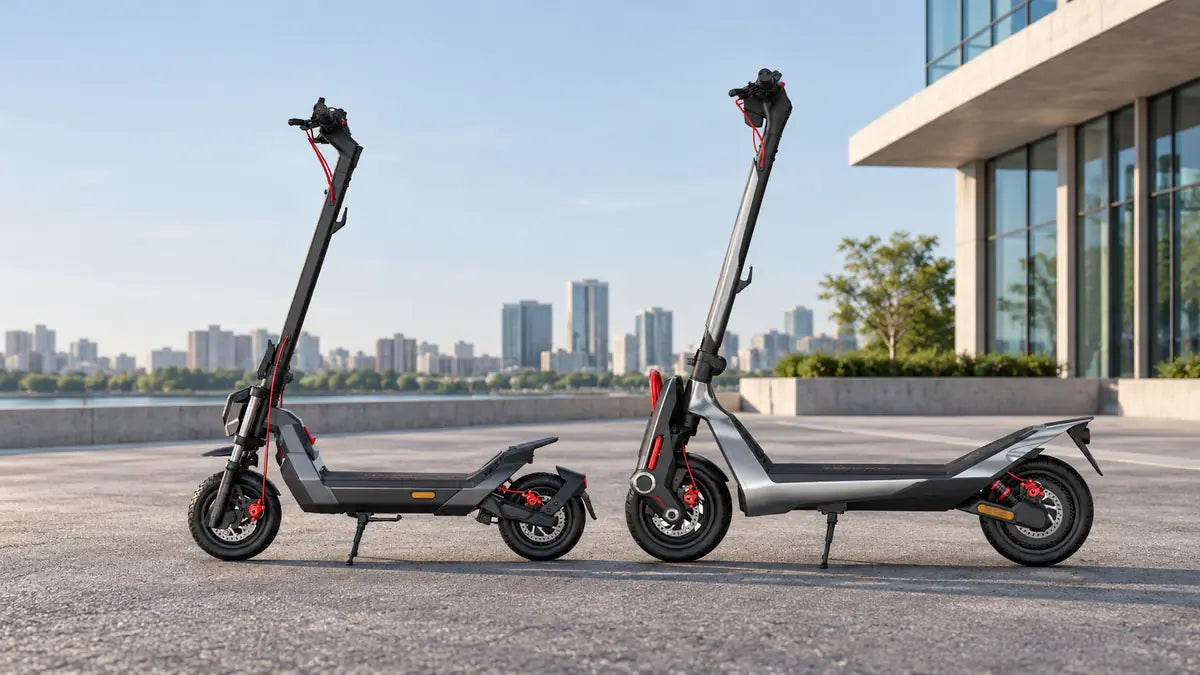
Cracked pavement, raised road joints, and uneven asphalt can make a familiar commute feel surprisingly rough. Tire size affects how the wheels meet those surfaces, but choosing between 10.5-inch and 12-inch tires involves more than picking the larger number.
Twelve-inch tires generally roll over small raised edges more progressively than 10.5-inch tires under comparable conditions. Whether that difference improves your daily ride also depends on tire construction, pressure, and suspension.
For mostly maintained pavement, a well-equipped 10.5-inch setup can provide the comfort you need. When uneven surfaces are frequent, 12-inch tires become more appealing.
10.5-Inch vs. 12-Inch Tires at a Glance
Tire size generally refers to the tire’s nominal outside diameter, not the rim diameter. Width is measured separately, so a 12-inch tire is not necessarily wider than a 10.5-inch tire.
These are general tendencies, not results from a controlled comparison. Differences in tires, suspension, and scooter design can outweigh the effect of diameter.
How Tire Size Affects Your Ride
Comfort on Uneven Roads
A larger wheel generally meets a small raised edge at a less abrupt angle. That can make pavement joints and uneven repairs feel less jarring.
The tire and suspension then manage the impact. Air-filled tires provide cushioning as they deform, while suspension allows the wheels to move relative to the frame and helps control that movement.
The practical takeaway is to compare both components together. A scooter with 10.5-inch pneumatic tires and effective suspension can still deliver a comfortable everyday ride, even when the pavement is imperfect.
Rolling Over Small Obstacles
Small-obstacle rollover is the clearest advantage of 12-inch tires.
Picture the raised lip of an asphalt patch. Under otherwise comparable conditions, a larger wheel rolls up that edge more progressively. This becomes more useful when your route includes repeated pavement breaks rather than an occasional bump.
There are limits. Larger tires do not make tall curbs, deep potholes, or large rocks safe to ride over. Approach speed, obstacle shape, ground clearance, and rider control still matter. Slow down for uncertain surfaces and avoid obstacles beyond the scooter’s capabilities.

Handling and Stability
Tire diameter contributes to handling, but it does not determine how quickly a scooter turns or how stable it feels.
Wheelbase, steering geometry, handlebar width, tire profile, and weight distribution all influence steering response. Larger wheels may feel less disrupted by small surface changes, but that does not automatically mean better cornering.
Grip requires a separate assessment. Rubber compound, tread, inflation pressure, load, and road conditions affect traction. A larger tire diameter alone does not guarantee a stronger hold on wet pavement or loose gravel.
Effects on Speed and Range
Neither tire size guarantees higher speed or longer range.
At the same wheel rotational speed, a larger wheel travels farther per revolution. Actual scooter speed also depends on the motor, controller, available power, and programmed limits.
Range depends on battery capacity, riding speed, rider weight, hills, temperature, and rolling resistance. A scooter with 12-inch tires may travel farther because it has a larger battery, rather than because its tires are larger.
For a useful comparison, look at range figures measured at similar speeds and loads. Test conditions can explain more of the difference than tire size.
Which Tire Size Fits Your Ride?
10.5-Inch Tires for Mostly Paved Routes
Ten-and-a-half-inch tires are a practical choice when maintained streets and paved paths make up most of your riding.
Focus on whether:
- The suspension handles your route’s occasional rough patches comfortably.
- The scooter provides enough range for your usual round trip.
- Its weight and folded dimensions fit your storage and carrying needs.
- The tire tread suits the surfaces you ride.
A 10.5-inch setup can support everyday commuting or performance-focused riding, depending on the motor, suspension, and overall design. There is little reason to choose a different scooter solely for larger tires when the complete setup already fits your route.

12-Inch Tires for Rougher Roads
Twelve-inch tires become more appealing when raised joints, broken pavement, and uneven repairs are regular parts of your journey.
Their rollover advantage can reduce the sharpness of encounters with small edges. Suitable suspension helps manage the repeated wheel movement that follows, making the combination particularly relevant to uneven routes.
For gravel or dirt, also check tread, ground clearance, suspension, and intended riding conditions. Diameter alone does not establish off-road capability.
Before buying, compare the scooter’s actual weight and folded dimensions with your stairs, storage space, or car trunk. Ride comfort and everyday practicality both matter.
Look Beyond Tire Diameter
Five details help turn a size comparison into a useful buying decision:
- Width and profile: These influence steering feel and tire behavior under load.
- Tread and compound: Match the tire to pavement, loose surfaces, or mixed routes.
- Construction: Tubeless and self-sealing designs offer different puncture-management features.
- Pressure: Follow the recommended inflation range and check it regularly.
- Suspension: Consider how the system absorbs impacts and controls movement over repeated bumps.
Understanding how suspension affects ride comfort helps explain why scooters with similarly sized tires can feel different on the same road.
Avoid lowering pressure below the recommended range simply to soften the ride. Underinflation can increase rolling resistance and the risk of tire or rim damage.
Self-sealing tires also need routine care. They can help seal certain small tread punctures, but they are not puncture-proof and cannot repair every type of damage.

NAVEE Models by Tire Size
Compare the tire and suspension configurations below to find the combination that fits your route.
10.5-Inch Options
The NAVEE NT5 Max pairs 10.5-inch tubeless tires with front dual telescopic and rear damping arm suspension. Together, these components address surface impacts through tire cushioning and controlled wheel movement.
Its single motor delivers 800W rated power and 1,900W peak power. Choose this configuration when you want the 10.5-inch tire and suspension setup without stepping up to dual motors.
The NAVEE NT5 Ultra X combines the same nominal tire diameter and suspension layout with dual 800W rated motors. The main distinction here is motor configuration, not wheel size.
When comparing these two models, weigh power requirements, battery capacity, range conditions, and weight. Shared tire dimensions do not make their overall performance identical.

12-Inch Options
For mixed paved and unpaved routes, the NAVEE XT5 Pro pairs 12-inch off-road tubeless tires with Damping Arm suspension. The larger diameter addresses rollover, while the off-road tire design and suspension should be considered alongside the surfaces you expect to encounter.
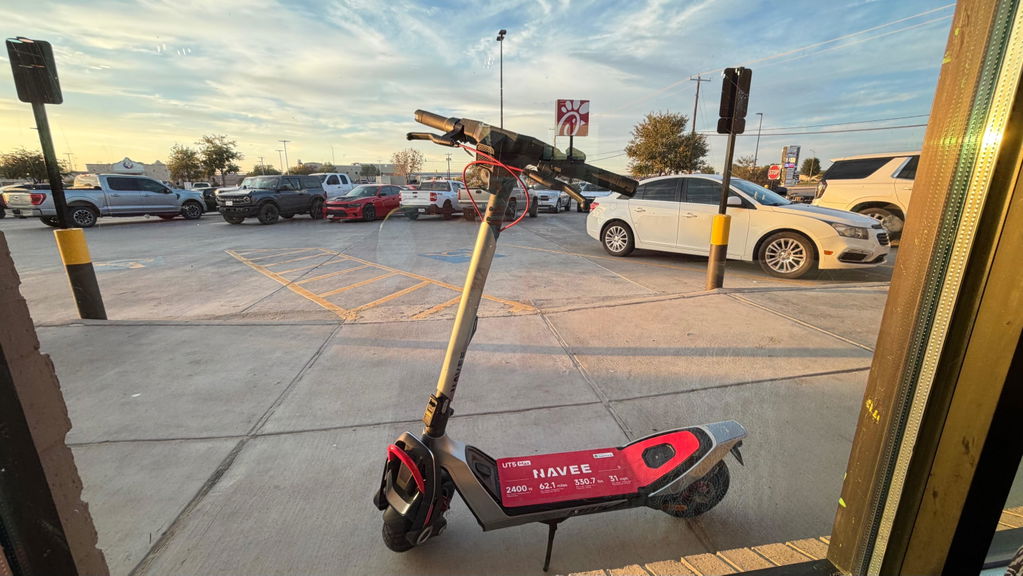
The NAVEE UT5 Max combines 12-inch self-healing tubeless tires with dual hydraulic suspension. This setup brings together larger-wheel rollover, suspension cushioning, and a feature that helps seal certain small tread punctures.
The UT5 Max weighs 75 pounds, making carrying and storage important parts of the decision. Its tire and suspension configuration may fit an uneven commute, while its weight determines how conveniently it fits the rest of your day.
Between these 12-inch options, focus on tire construction, suspension, terrain, and ownership needs rather than diameter alone.
FAQ
Are 12-Inch Tires Always Better?
No. Twelve-inch tires generally roll over small obstacles more progressively, but comfort and handling also depend on tire construction, pressure, suspension, and scooter geometry. A well-matched 10.5-inch setup can provide everything needed for mostly smooth pavement.
Are 10.5-Inch Tires Good for Rough Roads?
They can work well on moderately uneven pavement when paired with suitable suspension and maintained at the recommended pressure. For loose gravel, deep ruts, or larger obstacles, check the scooter’s tread, ground clearance, suspension, and intended use.
Can You Replace 10.5-Inch Tires with 12-Inch Tires?
Do not assume they are interchangeable. Compatibility depends on rim dimensions, tire width, frame and fork clearance, fender space, and other components. A size change can also affect handling, effective gearing, and speed readings. Use the approved replacement size unless the manufacturer confirms that an alternative is compatible
Share:
How to Choose a 48V Electric Scooter for Commuting?
Foldable Electric Wagons: A Storage Guide for Car and RV Camping