


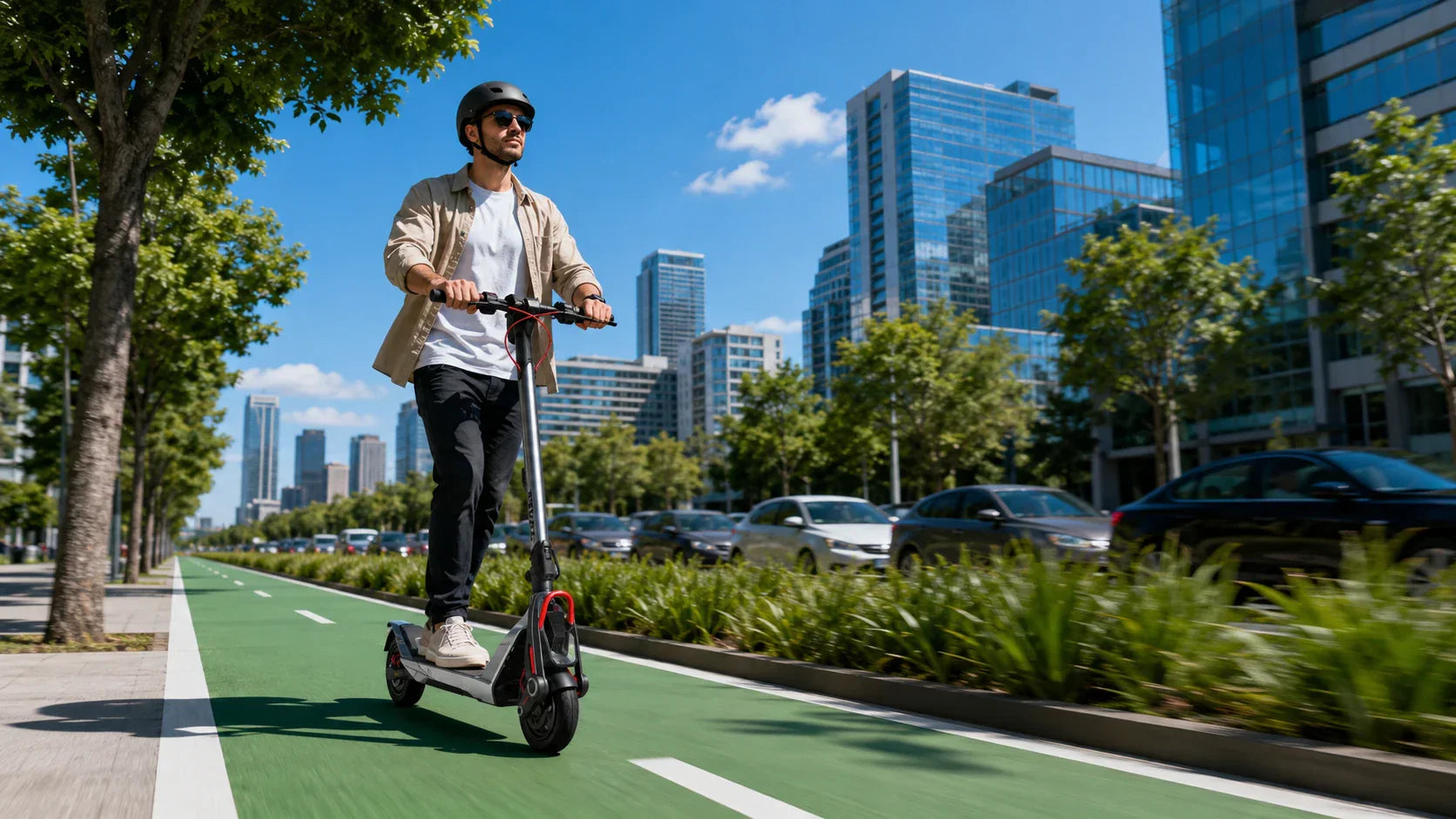
If you're looking to beat gridlock, slash your commute times, and skip the parking hassle entirely, a stand-up electric scooter is the ultimate urban ride.
This comprehensive guide gets straight to the point. We will break down exactly why these compact vehicles outshine traditional city transit, how to evaluate your specific daily route, the essential tech specs you need to check before buying, and how to choose the perfect model tailored to your city's unique terrain.
What Is a Stand-Up Electric Scooter?
At its core, a stand-up electric scooter is a lightweight, two-wheeled vehicle propelled by an electric motor. Unlike seated mopeds or electric bikes, you ride it standing upright on a narrow deck, steering with a set of T-bar handlebars. They are powered by rechargeable lithium-ion batteries and come equipped with hand brakes, throttles, and integrated lighting systems. Designed specifically for efficiency and agility, they bridge the gap between walking and full-scale driving.
What Makes a Stand-Up Electric Scooter Better for City Rides?
Compact Enough for Small Urban Spaces
Cities are crowded, and space is at a premium. Unlike cars or even bulky bicycles, stand-up e-scooters have an incredibly small footprint. They effortlessly glide through narrow bike lanes, tight alleyways, and congested downtown corridors where larger vehicles simply cannot fit.
Easy to Fold, Carry, and Store
One of the biggest advantages of an e-scooter is its folding mechanism. Most city-friendly models can be collapsed in under five seconds. Once folded, you can easily slide your scooter under a desk at work, stow it in a closet at home, or tuck it into the trunk of a car without breaking a sweat.
Quick and Practical for Short City Trips
Need to grab lunch six blocks away or pick up a quick prescription? Walking takes too long, and driving means losing your pristine parking spot. An e-scooter turns a tedious 20-minute walk into a breezy 4-minute zip, making short-distance errands incredibly practical.
Easy to Maneuver on Busy Urban Streets
With a tight turning radius and instant throttle response, stand-up scooters are highly nimble. They allow you to safely navigate around unexpected obstacles, pedestrians, and construction zones far more gracefully than a heavy bicycle or a clumsy moped.
Useful for First and Last Mile Travel
If you rely on public transportation, you know the struggle of the "first and last mile"—the distance between your front door and the train station, or the bus stop and your office. An e-scooter seamlessly fills this gap, transforming a multi-stage commute into a streamlined, stress-free journey.
Less Hassle With Parking and Daily Storage
The Ultimate City Luxury: Never paying for parking again.
With an e-scooter, you don't have to scout the block for an open spot or fork over cash for a parking garage. You simply fold it up and bring it inside with you. No locks required, and zero risk of sidewalk theft.

Is a Stand-Up Electric Scooter Right for Your City Commute?
Check Your Daily Distance and Trip Purpose
Before pulling the trigger on a purchase, map out your typical day. If your commute is under 10 miles round-trip, a standard commuter scooter is a no-brainer. If you are looking to travel much farther, you will need to prioritize premium battery capacity.
Evaluate Hills, Traffic, and Street Conditions
Take a close look at your city's infrastructure. Are you dealing with the flat, paved avenues of New York City, or the steep, punishing inclines of San Francisco? Do your local streets feature smooth asphalt, or are they a minefield of historic cobblestones and potholes? Your local terrain dictates exactly how much power and suspension you will need.
Consider Public Transit, Stairs, and Storage
If your daily route involves carrying your scooter up three flights of apartment stairs or boarding a packed subway car during rush hour, every pound matters. Be realistic about how often you will have to lift the scooter manually.
Decide How Much Portability You Need
There is always a trade-off in the scooter world:
-
High portability means a lighter battery and smaller motor (easier to carry, less range/power).
-
High performance means a massive battery and dual motors (heavy to lift, but rides like a dream).
Before you buy, think about how you're willing to compromise between these two options.
Key Features to Check Before Buying a Scooter for City Riding
Real-World Range
Advertised range is often calculated using a 140-pound rider cruising on flat ground at minimum speed. For real-world utility, take the manufacturer's stated range and subtract 30% to 40%. Look for a scooter that comfortably exceeds your daily round-trip mileage on paper so you never suffer from range anxiety.
Motor Power and Hill-Climbing Ability
Motor power is measured in watts (W). On flat surfaces, a 250W to 350W motor is sufficient. However, if your commute involves moderate or steep inclines, you should choose a motor rated at 500W or higher (or dual motors) to ensure you don't painfully stop while climbing hills.
Scooter Weight and Folding Design
For urban commuting, a scooter should balance portability with stability. Lighter models are easier to carry upstairs or onto public transit, while heavier frames may feel more stable on the road. Look for a secure, easy-to-use folding mechanism that locks firmly in place and does not wobble, loosen, or squeak when the handlebars are moved. A compact folded size also makes the scooter easier to store at home, at work, or in other tight spaces.
Tire Type
A vehicle's ride quality is affected by its tires:
-
Pneumatic (Air-Filled) Tires: Offer excellent natural shock absorption and grip, but are prone to flats from city debris.
-
Solid (Airless) Tires: Completely maintenance-free and puncture-proof, but deliver a much harsher ride unless paired with a good suspension system.
-
Tubeless Tires: Deliver excellent grip, high-speed stability, and pneumatic-like comfort with a much lower risk of sudden blowouts, but carry higher upfront costs and trickier repairs.
-
Self-Healing Tubeless Tires: Automatically seal small punctures while maintaining strong grip, low road noise, and good comfort, but are typically heavier and more expensive.
If you want to experience the worry-free comfort of premium tire engineering firsthand, check out the NAVEE ST3 Pro. It comes equipped with 10-inch self-healing tubeless tires paired with a plush damping arm suspension, ensuring a smooth, flat-free ride through unpredictable city streets.
Braking System and Safety Lighting
City riding requires split-second stops. Look for scooters with mechanical disc brakes or drum brakes, ideally on both the front and rear wheels. Electronic regenerative brakes are a nice bonus, but shouldn't be your primary stopping power. Furthermore, ensure the scooter features a bright, high-mounted LED headlight and a flashing rear brake light for nighttime visibility.
Water Resistance and Build Quality
The weather is unpredictable. Check the scooter’s IP (Ingress Protection) rating. An IPX4 rating means it can handle splashes from any direction, while an IPX5 rating means it can survive light rain and wet roads. Avoid scooters with no listed IP rating if you plan to ride year-round.

Choose the Right Scooter for Your City Commute
Lightweight Models for Transit and Apartments
If your priority is jumping on and off the bus or carrying your ride up to a fifth-floor walk-up, look into ultra-portable models. These trade away massive range and top speed in exchange for an incredibly slim, lightweight frame that won't strain your back.
Comfortable Models for Rough City Streets
If your commute is longer and your city has uneven pavement, prioritize ride comfort. Models like the NAVEE ST Series feature a front and rear damping arm suspension system. This setup reduces vibrations from cracked concrete and road bumps, providing a more stable and comfortable daily ride.
More Powerful Models for Hilly Routes
If your city is notorious for steep inclines, look for a high-torque model. Options like the NAVEE NT Series feature higher-voltage batteries and robust motors designed to maintain steady power and consistent speed when climbing hills.
Check Local Electric Scooter Rules Before You Buy
Before clicking "Add to Cart," familiarize yourself with your local municipal laws. Micro-mobility regulations vary wildly from city to city:
-
Some cities ban riding on sidewalks entirely, requiring you to stick strictly to bike lanes or public roads.
-
Many municipalities enforce a strict top speed limit (typically 15 to 20 mph) for electric micro-mobility devices.
-
Certain states mandate helmet usage for all riders, regardless of age.
Staying compliant keeps you safe and protects your wallet from costly tickets.
Final Thought
The perfect electric scooter isn't just the most expensive model—it’s the one that fits your specific environment. By balancing your daily mileage, local terrain, and portability needs, you can ditch gridlock, skip parking fees, and completely reclaim your daily commute.
Ready to revolutionize your city ride? Explore the innovative, high-performance commuter lineups from NAVEE to find your perfect match today!
FAQs
Do I need a driver's license to ride a stand-up electric scooter?
In most US states and cities, you do not need a driver’s license or specialized permit to ride a standard electric scooter with a top speed under 20 mph. However, exceptions exist—states like California require riders to possess at least a valid learner's permit or driver's license. Many municipalities also enforce a minimum riding age, typically 16 or 18.
How long does an electric scooter battery last before it needs to be replaced?
Most high-quality lithium-ion scooter batteries are rated for 300 to 500 complete charge cycles. For the average daily commuter, this translates to roughly 2 to 3 years of consistent riding before you will see a noticeable drop in your maximum range and overall battery performance.
What is the typical weight limit for an adult electric scooter?
Most standard adult commuter scooters have a maximum weight capacity of 220 pounds (100 kg). Exceeding this limit won't instantly break the frame, but it will severely drag down your acceleration, hill-climbing capabilities, and battery range. If you carry a heavy backpack or need a higher capacity, look for heavy-duty models rated for 265 to 300 pounds.
More reading:The Heavy Rider’s Guide: How to Choose the Best Electric Scooter for Adults 300 lbs
Share:
Electric Scooter Laws In Texas: Rules, Age Limit, And Where You Can Ride
Are There Smart Locks Available for Electric Scooters?