


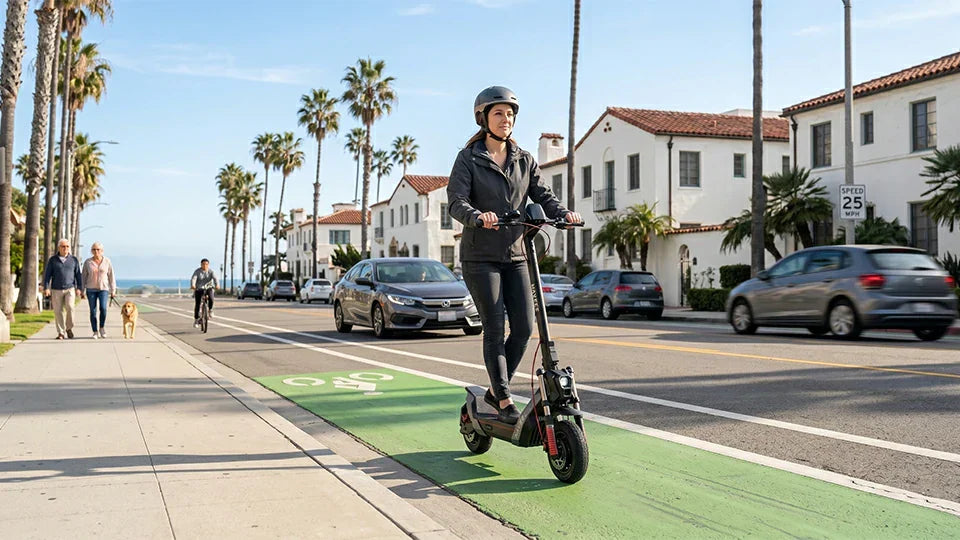
Electric scooters are changing the way people move through California's cities and coastal towns — but before you push off and hit the throttle, you need to know that the Golden State has some of the strictest micro-mobility regulations in the country by now.
To ride an electric scooter legally on public roads in California, you must be at least 16 years old and carry a valid driver's license or instruction permit (any class). Your riding speed is capped at a maximum of 15 mph, riding on sidewalks is illegal statewide, and helmets are legally mandatory for any rider under 18. Violating any of these rules can result in fines of up to $250 per citation.
Whether you're simplifying your daily commute or exploring California's coastline on two wheels, this guide covers everything you need to stay safe, legal, and ticket-free on California streets.
California Electric Scooter Rules: Core Laws Every Rider Must Know
Familiarizing yourself with California's primary traffic codes ensures a smooth ride and helps you share public spaces safely with cars and pedestrians. All of the rules below are established under California Vehicle Code § 21235 and related sections, enforced statewide.
The 15 MPH State Speed Limit
California Vehicle Code caps the maximum speed of a motorized stand-up scooter at 15 mph on all public paths, bike lanes, and roadways. It does not matter if your personal scooter is engineered to go faster, or if surrounding traffic is moving at 35 mph — your legal limit on public infrastructure remains 15 mph.
The Strict Statewide Sidewalk Ban
Riding an electric scooter on a sidewalk is completely illegal across the entire state of California. Sidewalks are reserved exclusively for pedestrians. The only legal exception is when you are moving a stopped scooter to or from adjacent property — for example, pushing it carefully by hand toward a storefront or street curb.
Recommended Reading: Want to know how these sidewalk restrictions apply across the rest of the country? See our full guide: Can You Ride an Electric Scooter on the Sidewalk?
Street Riding and Approved Bike Lanes
California law requires you to ride inside a designated bike lane whenever one is available on your route. If no bike lane exists, you may ride on the right side of the street — but only where the posted speed limit for cars is 25 mph or lower. Riding alongside high-speed traffic on roads above 25 mph is prohibited.
License, Age, and Safety Gear Requirements
While you do not need to register a stand-up electric scooter with the California DMV or carry vehicle insurance, you must still meet basic operator criteria before riding on public pavement.
Minimum Age and Driver's License
You cannot legally ride an electric scooter on public infrastructure unless you are at least 16 years old. Because scooters are classified as motorized vehicles, the state also requires a valid driver's license or a learner's permit. Any standard class of license fulfills this requirement.
Helmet Rules for Minors and Adults
Riders under 18 must wear a properly fitted and fastened bicycle helmet by law. For adults aged 18 and older, wearing a helmet is no longer a legal mandate on public streets — though traffic safety authorities strongly recommend head protection for all riders regardless of age.
The Single-Rider Rule
Electric scooters are engineered, balanced, and legally designated for one person only. Carrying a passenger — often called tandem riding — is strictly prohibited under California vehicle codes.

Required Vehicle Hardware and Safety Standards
California sets clear technical benchmarks for scooter hardware to guarantee structural safety on public roads.
Lights and Reflectors for Night Riding
If you ride between sunset and sunrise, your scooter must have specific safety lighting. State law requires a front headlight emitting white light visible from 300 feet, a red reflector on the rear, and yellow or white reflectors on the sides of the vehicle. Riding at night without compliant lighting is a citable offense and a genuine safety risk.
Legal Braking Distance Requirements
To be street-legal, your scooter must feature a braking system strong enough to produce a braked wheel skid on dry, level, and clean pavement. Responsive brakes are essential when navigating busy urban intersections — look for models that specify dual independent braking systems covering both front and rear wheels.
Battery Safety and State Certifications
California actively enforces rigorous testing standards for battery packs. When buying a personal scooter, always verify that the vehicle's battery system carries third-party certifications such as UL certification. Uncertified battery packs represent a fire risk that no riding skill can mitigate. Learn more about what to look for in our Electric Scooter Battery Safety Guide.
City-Specific Rules: What California Cities Add on Top
State law sets the minimum standard — individual California cities can and do layer additional regulations on top of it.
Los Angeles follows state law closely, but beach-adjacent areas including Venice and Santa Monica have additional enforcement presence and designated scooter parking corrals. Leaving a scooter outside designated zones can result in impoundment.
San Francisco has strict parking requirements: scooters must be parked upright in designated corrals or at bike racks, with at least three feet of clear walking space for pedestrians. The city actively tickets improperly parked scooters, and some downtown zones have scooter-free designations.
San Diego generally applies state law, but specific neighborhoods and the downtown core may have additional local ordinances. Always check with your city's transportation department for the most current local rules before your first ride in a new area.
When in doubt, treat the state rules as your floor and assume your local city may be stricter.
California Electric Scooter Fines and Penalties
Disregarding California's electric scooter laws can result in costly citations. Officers across the state actively enforce these rules on shared roadways.
| Violation | California Vehicle Code | Estimated Fine |
|---|---|---|
| Riding on a Sidewalk | CVC § 21235(g) | ~$200 |
| Exceeding the 15 MPH Limit | CVC § 22411 | Up to $250 |
| Riding Without a License or Permit | CVC § 21235(d) | ~$200 |
| Riding Under 18 Without a Helmet | CVC § 21235(c) | ~$197 |
| Carrying a Passenger (Tandem) | CVC § 21235(e) | ~$200 |
Choosing a California-Compliant Electric Scooter
Understanding the rules is only half the equation — your scooter itself also needs to satisfy California's technical requirements. The four criteria that matter most for legal compliance are speed control, lighting, braking, and battery certification. Here's how each maps to the scooters worth considering.
Speed Control: Staying at 15 MPH Where It Counts
California's 15 mph cap applies equally on flat ground and on hills — but on a steep San Francisco or Marin County incline, a low-powered scooter will slow to 8–10 mph even at full throttle, creating a hazard for traffic behind you. Higher-torque motors don't make you ride faster illegally; they give you enough power to hold the legal 15 mph limit on gradients that would otherwise cause your scooter to labour and slow.
The NAVEE UT5 Max (2,400W peak motor) and NAVEE XT5 Pro (dual 2,200W motors) both offer multiple speed modes configurable through the NAVEE app — you can set a 15 mph speed ceiling so the scooter physically cannot exceed the legal limit, removing any ambiguity about compliance. This is particularly useful if you ride across a mix of bike lanes, residential streets, and hill sections in the same commute.
Lighting: Meeting California's 300-Foot Standard
State law requires a front white light visible from 300 feet, a rear red reflector, and side reflectors. Budget scooters frequently ship with 100–150 lumen headlights that fail this standard in practice. Look for models with headlights rated at 300 lumens or above, and factory-installed side and rear reflectors — not aftermarket additions.
The NAVEE NT5 Max features signature low-position family-style headlights designed to illuminate the road surface directly in front of the wheel — the exact zone where California's hazards (painted lines, drain grates, kerb edges) appear. All three models include factory side reflectors and rear lights that meet the state's night-riding specifications out of the box. For a deeper look at what night-riding lighting standards require, see our Electric Scooter Lights and Night Riding Guide.
Braking: Passing California's Skid Test
California requires a braking system capable of producing a wheel skid on dry, level pavement — a test that single-brake or drum-only systems frequently fail at urban speeds. Dual independent disc braking, combining a mechanical front disc with a rear disc and electronic EABS, is the reliable way to meet and exceed this standard.
All three recommended models — NT5 Max, UT5 Max, and XT5 Pro — feature dual disc brakes plus EABS as standard. TCS (Traction Control System) is also included across the lineup, preventing rear-wheel spin during acceleration on the wet road surfaces common in coastal California cities.
Battery Certification and Parking Compliance
California enforces UL certification standards for battery packs to prevent electrical and fire hazards. NAVEE's lineup uses certified lithium-ion battery systems built to international safety standards — verify certification details on the product page before purchase.
For parking: California cities including San Francisco and Los Angeles actively impound scooters left outside designated zones. All three models include native Apple Find My integration and app-driven electronic motor locks, giving you real-time location alerts the moment the scooter moves without your phone nearby. For outdoor parking security, always use a quality hardened U-lock in addition to the electronic lock — cable locks provide no meaningful protection against bolt cutters.

Easy Steps to Start Riding Legally in California
Before stepping onto the deck, run through this quick checklist:
- Grab your license: Confirm your physical driver's license or instruction permit is with you.
- Verify age: All riders must be at least 16. Any rider under 18 must be wearing a securely buckled helmet.
- Inspect the hardware: Test your brakes on flat ground. Confirm the front headlight and all reflectors are clean and functional.
- Map your route: Plan a path using designated bike lanes or residential streets where the car speed limit is 25 mph or below. Stay off sidewalks and all highways.
- Park correctly: At your destination, stand the scooter upright at a bike rack or designated corral, leaving at least three feet of clear walking space for pedestrians.
FAQs
1. Do you need a license to ride an electric scooter in California?
Yes. California requires all electric scooter riders on public infrastructure to carry a valid driver's license or instruction permit. Any standard class of license qualifies. You do not need a motorcycle-specific license or any special endorsement.
2. Are electric scooters street legal in California?
Yes, under specific conditions. Electric scooters are legal on roads where the car speed limit is 25 mph or lower, and in designated bike lanes on any road. They are not permitted on sidewalks, highways, or expressways under any circumstances.
3. Can you ride an electric scooter on the highway in California?
No. Expressways, freeways, and highways are strictly off-limits for electric scooters. Riders must stay on city streets with a posted car speed limit of 25 mph or below, or in a designated bike lane.
4. Do you need insurance for an electric scooter in California?
No. Standard stand-up electric scooters do not require liability insurance, DMV registration, or license plates under current California law.
5. Can a 14-year-old ride an electric scooter in California?
No. California state law requires all electric scooter operators on public infrastructure to be at least 16 years old, and to hold a valid license or instruction permit.
6. Can you get a DUI on an electric scooter in California?
Yes. Operating an electric scooter under the influence of alcohol or drugs is illegal under California Vehicle Code § 21221.5. A scooter DUI can result in a base fine of approximately $350 and can affect your driving record.
7. Are NAVEE electric scooters legal in California?
Yes. NAVEE's adult electric scooter lineup is fully street-legal in California. All models are engineered with compliant dual-braking systems, required lighting arrays for night riding, certified battery safety systems, and multiple speed modes to help riders maintain the 15 mph legal limit — including on the steep hills where lower-powered scooters fall short.
Ready to Ride California Streets?
Navigating California's electric scooter laws is straightforward when you ride a vehicle built for compliance from day one. NAVEE's main lineup combines high-torque motors for California's hills, dual disc braking, certified battery safety, and Apple Find My integration — everything the state requires, and more.
- NAVEE NT5 Max — $1,399.99 — The city commuter built for daily compliance: dual disc brakes, 220 mm wide deck, IPX6 water resistance, and ultra-bright headlights that meet California's night-riding requirements.
- NAVEE UT5 Max — $1,799.99 — The hill climber: 2,400W peak motor, dual hydraulic suspension, and 100 km range for California commutes that include serious elevation changes.
- NAVEE XT5 Pro — $1,499.99 — For California riders whose routes go beyond smooth pavement: 12-inch all-terrain tubeless tires, dual oil disc brakes, and all-wheel drive capability.
Share:
Best Electric Scooters For Women: Weight, Fit, Safety, and Range Guide
How to Choose the Most Compact Electric Scooter for Travel