


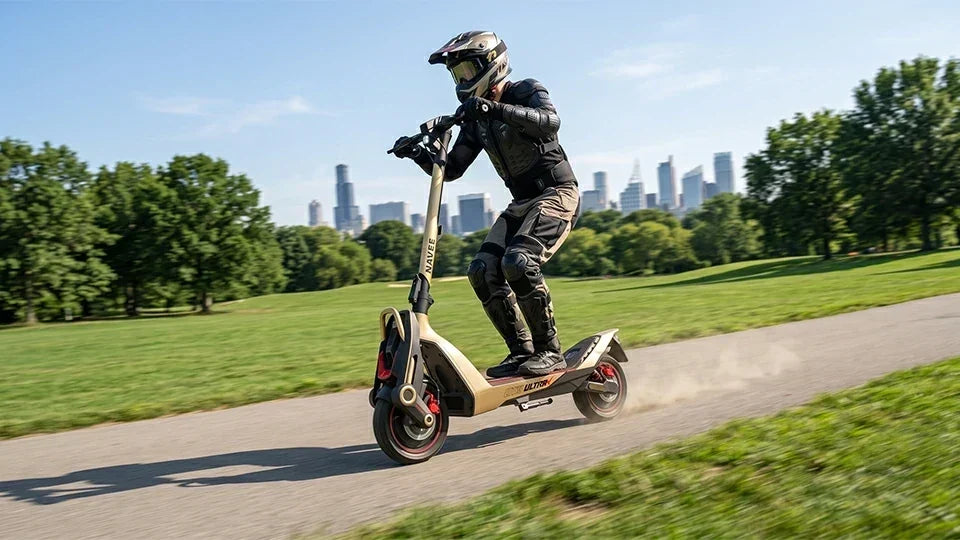
In the United States, low-speed electric scooters (capped under 20 mph) rarely require mandatory insurance under state motor vehicle laws. However, carrying dedicated electric scooter insurance is strongly recommended for daily commuters to protect against third-party liability claims, hardware theft, and personal injury costs. Standard US homeowners, renters, and auto insurance policies almost universally exclude riding accidents, street liability, and un-titled light electric vehicles (LEVs).
Zipping through morning traffic at 20 mph on an electric scooter is fast, efficient, and surprisingly fun. However, operating alongside multi-ton cars, crowded city sidewalks, and unpredictable road hazards carries real-world financial risks. Whether you are daily commuting on a lightweight urban model, navigating long city routes, or riding a high-performance all-terrain scooter, protecting your hardware investment and personal savings is essential.
In this comprehensive guide to Electric Scooter Insurance: What You Need to Know, we break down everything required to protect your wallet and ride with complete confidence—from navigating fine-print exclusions in your current US home and auto policies to picking the exact coverage strategy for your riding style.
Do You Need Insurance For An Electric Scooter In The US?
A common question among new and experienced American riders alike is: do you need insurance for an electric scooter?
The short answer comes down to two primary considerations: local municipal regulations and your personal financial risk tolerance.
1. US State Laws And Municipal Regulations
Across most US states, electric scooters that operate under 20 mph and feature motor outputs under 750W are classified as light electric vehicles rather than motor vehicles. State departments of transportation (like the California DMV) generally do not mandate vehicle registration, licensing, or compulsory liability insurance for these low-speed commuters. For a deeper state-by-state breakdown of riding rules, check out our guide on electric scooter laws in the U.S. to ensure you remain fully compliant. However, local city ordinances, university campuses, and municipal transit hubs frequently update riding zones and sidewalk speed limits, making it vital to check your city's specific micro-mobility codes to avoid unexpected traffic citations.
2. Personal Financial Risk And Asset Protection
Even when state law does not strictly force you to carry coverage, riding uninsured leaves your personal savings exposed. If you accidentally collide with a pedestrian or scratch a parked car, out-of-pocket medical bills and property damage claims can easily reach tens of thousands of dollars. Buying specialized personal electric vehicle insurance ensures that a single split-second mistake does not turn into a devastating personal lawsuit.
Why Your Current Home Or Auto Insurance Probably Will Not Cover You
Many riders assume their existing US homeowners, renters, or car insurance policies automatically extend to their e-scooter. In reality, relying on traditional insurance policies often leaves major coverage gaps.
The Homeowners And Renters Motorized Vehicle Exclusion
While a standard renters or homeowners policy might reimburse a stolen scooter if someone breaks into your private home or garage, that protection usually ends at your property line.
More importantly, standard US home insurance policies almost universally exclude third-party liability for motorized land vehicles operating on public roads or city bike lanes. On top of that, standard deductibles ($500 to $1,000) mean filing a home insurance claim for an $800 stolen scooter yields almost zero net payout while risking an increase in your annual home premiums.
Auto Insurance Policy Limitations
Calling your auto insurance provider to add an electric scooter rarely works. Standard US auto policies require a state-issued vehicle title, VIN, and license plate. Because light electric vehicles (LEVs) are un-titled across almost all US jurisdictions, auto insurers will reject coverage outright.
Personal Health Insurance Vs Liability
If you wipe out on a hidden pothole, your personal health insurance will help cover your emergency room visits and medical treatment (after meeting your deductible). However, health insurance pays zero dollars for third-party medical claims or vehicle repair costs if you collide with someone else.

Types Of Electric Scooter Insurance Policies Explained
To fill these coverage gaps, specialty US insurance carriers offer dedicated policies tailored specifically to personal electric vehicles (PEVs). According to educational guidance from the Insurance Information Institute (III), standard light electric vehicle policies are generally structured around four primary coverage pillars:
e-Scooter Liability Insurance: Covers pedestrian injuries, medical bills, third-party property damage, and legal defense fees.
e-Scooter Theft Coverage: Reimburses hardware replacement value if your scooter is stolen from public bike racks, transit hubs, or garages.
Comprehensive Hardware Protection: Reimburses repair costs after crashes into curbs, potholes, or obstacles.
e-Scooter Medical Payments: Pays out-of-pocket health insurance deductibles, copays, and roadside emergency towing.
Important Information: The insurance concepts outlined below are for general educational and informational purposes only. NAVEE is an electric mobility vehicle manufacturer and does not write, sell, or solicit insurance policies. Coverage options, policy limits, deductibles, and exclusions vary significantly by state, local jurisdiction, and insurance carrier. Always consult a licensed local insurance agent or specialty insurer to verify policy availability and exact coverage details before purchasing.
1. e-Scooter Liability Insurance
Third-party liability is the most critical component of any policy. If you accidentally hit a pedestrian on a city sidewalk or clip a luxury vehicle in traffic, e-scooter liability insurance covers the third party's medical expenses, lost wages, vehicle repair bills, and your legal defense costs if you are named in a personal injury lawsuit.
2. e-Scooter Theft Coverage
Modern commuters invest anywhere from $500 to over $2,000 in reliable hardware. Comprehensive e-scooter theft coverage reimburses the replacement value of your scooter if it is stolen from a workplace bike rack, subway station, or shared residential parking area.
Note: Insurers usually require proof of lock cut marks and compliance with specific security standards (such as Sold Secure Gold or Diamond rated U-locks).
3. Collision And Hardware Damage Coverage
If you lose control on wet pavement or strike a deep road hazard, collision coverage pays to repair or replace your damaged frame, motor, or battery components.
4. e-Scooter Medical Payments And Roadside Assistance
Supplemental e-scooter medical payments coverage helps pay for your out-of-pocket health insurance deductibles, copays, or emergency transport fees following a solo riding accident. Optional roadside assistance provides transport towing if you suffer a flat tire or battery drain far from home.
Step-By-Step Guide To Deciding If You Need Insurance
Evaluating your individual risk profile doesn't have to be complicated. Follow these four key evaluation steps to decide whether to purchase a standalone policy, add an umbrella rider, or self-insure:
- Motor & Speed Check: Is your scooter's top speed over 20 mph or motor output above 750W?
- Hardware Value: Is the hardware replacement cost greater than $1,000?
- Commute Environment: Do you ride in dense urban traffic or crowded city corridors daily?
- Local Regulations: Are there municipal ordinances or campus rules governing your commuting path?
Step 1: Evaluate Your Scooter's Speed And Motor Output
- Below 15.5 mph (25 km/h) & 250W–500W: Low legal risk. Basic liability or self-insurance is often sufficient.
- Above 20–30+ mph & Dual Motors: High liability and collision risk. Dedicated electric scooter insurance is strongly recommended.
Step 2: Calculate Hardware Replacement Cost
Compare your scooter's current market value against standard policy deductibles ($100–$250). If replacing your scooter out of pocket would cause serious financial strain, purchasing theft and collision coverage is a smart move.
Step 3: Assess Your Daily Riding Environment
If your daily route involves dense downtown traffic, shared pedestrian plazas, or high-crime transit parking hubs, third-party liability and theft protection become essential.
Step 4: Verify Regional Compliance Rules
Check whether your local transportation authority requires registration or proof of insurance before riding on public bike paths or streets.
How To Choose The Right Protection Strategy For Your Scooter Category
Your insurance strategy should directly match your vehicle category, motor output, and daily riding environment.
1. Entry-Level & Practical Daily Commuters
- Riding Profile: Short-to-medium urban rides, bike lane travel, low-to-moderate top speeds. Explore our lineup of versatile city electric scooters designed for everyday urban transit.
- Recommended Strategy: Paying high annual insurance premiums for entry-level models is often unnecessary. Pairing a heavy-duty, angle-grinder-resistant U-lock with a personal self-insurance fund ($20/month) is usually sufficient. If riding in heavy traffic, an optional low-cost liability rider offers basic protection against minor traffic bumps.
2. Premium Comfort & Long-Range Commuters
- Riding Profile: Long daily journeys, suspension-equipped city models, higher replacement value, frequently parked in shared public garages or workplace hubs. Browse dedicated long-range commuter electric scooters built for maximum stability and distance.
- Recommended Strategy: Higher-tier commuter hardware represents a significant investment. Opting for a Standalone PEV Policy that covers both theft and third-party liability is ideal. Look for policies offering full purchase price hardware replacement rather than depreciated cash value.
3. High-Performance & All-Terrain Scooters
- Riding Profile: High speeds (25+ mph), dual-motor outputs, steep hill climbing, rough pavement, and recreational off-road routes. Check out our high-powered all-road electric scooters engineered for hills and rough terrain.
- Recommended Strategy: Given the increased speeds and power output of an all-terrain electric scooter, carrying a High-Limit Liability Policy ($100,000+) bundled with collision damage protection is essential. Always confirm that your insurer permits dual-motor configurations before purchasing a policy.
Comparison of Vehicle Configurations and Insurance Coverage Strategies
| Scooter Category | Primary Focus | Primary Risk Profile | Recommended Insurance Approach |
|---|---|---|---|
| Entry Commuter | Practical city transit & value | Public rack theft & minor scuffs | Self-insurance fund + heavy-duty U-lock; optional basic liability. |
| Premium Commuter | Long city routes & comfort | Shared garage theft & dense traffic | Standalone PEV policy with theft and full hardware replacement. |
| All-Terrain / Performance | Dual motor, high speed, hills | High-speed collisions & terrain impact | High-limit liability ($100k+) bundled with collision coverage. |
Actionable Checklist Before Buying A Policy Or Riding
Use this practical checklist to ensure your coverage remains valid when you need it most:
- [ ] 1. Store Essential Hardware Specs: Keep your original sales receipt, serial number, motor wattage rating, and top speed specs in a safe digital folder.
- [ ] 2. Check Approved Lock Ratings: If your policy includes theft coverage, verify whether your insurer mandates a Sold Secure Gold or Diamond certified lock. Keep the lock receipt as proof.
- [ ] 3. Request Written Exclusions from Your Agent: If relying on homeowners or renters insurance, ask your agent in writing: "Does this policy cover third-party liability if I hit a pedestrian on a city street while riding an electric scooter?"
- [ ] 4. Always File a Police Report Within 24 Hours: Insurers will reject theft and crash claims without an official police report number.
- [ ] 5. Watch Out for Usage Exclusions: Never use a personal scooter for commercial gig delivery (like DoorDash or UberEats) under a personal policy, and avoid letting unlisted friends ride if your policy excludes permissive use.

FAQs About Electric Scooter Insurance
1. Does Homeowners Insurance Cover A Stolen Electric Scooter?
Homeowners insurance may cover a stolen scooter only if it was taken during a break-in at your private home or garage. However, it usually excludes theft on public streets and provides zero liability coverage once the scooter leaves your property line. High policy deductibles ($500–$1,000) also limit its usefulness for lower-cost models.
2. What Should You Do Immediately After An E-Scooter Accident?
- Ensure Safety First: Move out of active traffic and check for injuries. Call emergency services if needed.
- Document the Scene: Take clear photos of vehicle positions, road conditions, skid marks, property damage, and hardware serial numbers.
- Exchange Information: Collect contact details, driver's license numbers, and insurance information from all involved parties and witnesses.
- File a Police Report: Request an official police report on the spot—specialty insurers require this incident report number to process claims.
- Notify Your Insurer(if you got one): Contact your insurance provider within 24 hours to initiate your claim.
3. How Much Does Electric Scooter Insurance Cost Per Year?
On average, basic standalone liability policies in the US cost between $100 and $150 per year. Comprehensive policies covering theft, collision damage, and personal injury typically range from $200 to $400+ per year, depending on your location, scooter replacement value, motor power, and riding history.
4. Will Insurance Cover A Friend Riding My Electric Scooter?
Most basic policies restrict coverage to the primary named policyholder. Allowing a friend or family member to ride without adding a "permissive use" rider to your policy can result in denied claims if an accident occurs. Always check your policy's permissive use clause before sharing your ride.
Final Thoughts: Ride Prepared, Ride Protected
Electric scooters deliver unmatched urban freedom, low carbon footprints, and smooth daily commutes. But as micro-mobility continues to grow across American cities, protecting your finances from traffic hazards and hardware theft is just as vital as wearing a quality helmet.
By picking the right protection strategy for your riding style—whether that means relying on robust security locks for daily city commutes or carrying comprehensive liability coverage for high-performance, all-terrain rides—you can hit the road with complete confidence.
Ready to find your ideal ride? Explore NAVEE's full lineup of premium adult electric scooters today!
Share:
Are Electric Scooters Legal in Florida? 2026 Rider's Guide & Rules
Electric Scooter for Delivery: Top Models & Essential Buying Guide