


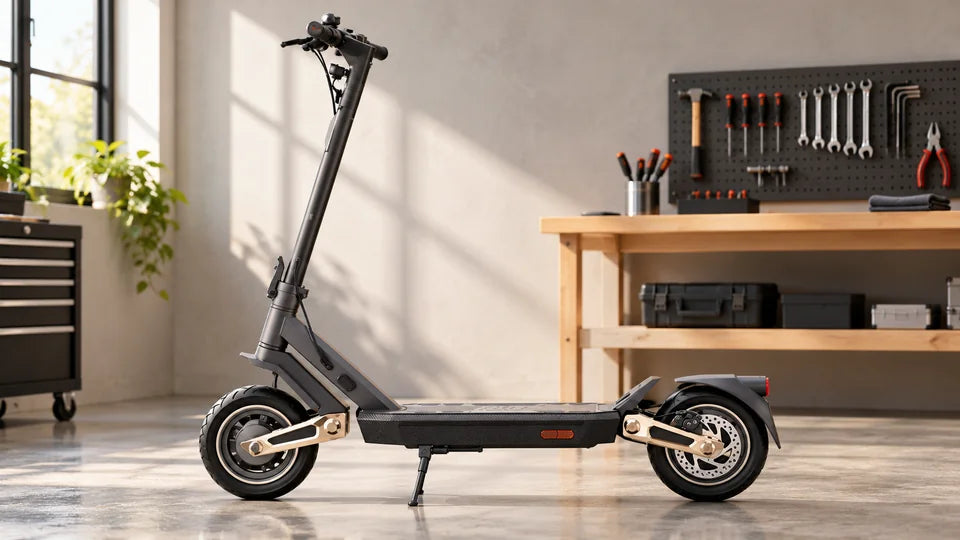
An electric scooter battery replacement can restore range lost as the original pack wears out. A battery upgrade aims to add capacity or change performance. The right choice depends on your goal and whether the complete pack is compatible with the scooter.
Voltage, charging requirements, current capability, battery electronics, wiring, and mounting must all be compatible. A matching voltage label or connector is not enough. Some specifications must match the approved design; others must meet its operating requirements.
Battery Upgrade vs. OEM Replacement
Restoring Original Performance
OEM stands for original equipment manufacturer. The correct OEM replacement is a factory-spec battery supplied for your scooter through the manufacturer or an authorized parts provider.
Replacing a degraded pack restores the original battery specification. It does not raise the scooter’s designed speed limit or motor rating.
Confirm the cause of reduced range before buying. Cold weather, low tire pressure, heavier loads, and faster riding can also shorten a trip. A fresh battery will not eliminate those effects.
Increasing Battery Capacity
A capacity upgrade stores more energy. A voltage upgrade changes the voltage supplied to the electrical system and requires a broader system evaluation.
An aftermarket battery comes from another supplier. It may match the original specifications without adding capacity or performance.
If the scooter’s original range met your needs, the correct OEM replacement is usually the simplest choice.
| Option | Main purpose | Key condition |
|---|---|---|
| OEM replacement | Restore original battery performance | Use the approved part for the exact scooter model |
| Higher-capacity upgrade | Increase stored energy | Confirm approval, electrical compatibility, secure fit, and charger compatibility |
| Higher-voltage conversion | Change operating voltage | Evaluate the complete electrical system rather than treating it as a direct replacement |

What Must Match?
Scooter Model and Part Number
Start with the exact model and serial number. Similar model names do not guarantee shared battery parts, and specifications can vary across regions or production runs.
Confirm the approved battery part number. A newer replacement may carry a different number, but the manufacturer should identify it as a suitable substitute for the original.
Nominal and Maximum Charge Voltage
Nominal voltage is the battery’s rated operating voltage. Actual voltage changes as the pack charges and discharges. Maximum charge voltage is the specified upper charging voltage.
For example, a common 36V lithium-ion pack may charge to 42V. This is an illustration, not a rule for every battery labeled 36V.
Check the replacement’s nominal voltage, maximum charge voltage, and discharge limits against the scooter’s approved specifications. The controller’s low-voltage cutoff must also suit the pack so normal operation does not rely on repeated emergency shutdowns by the battery’s protection system.
A higher-voltage battery can exceed the ratings of the controller and other electronics even when it fits inside the deck.
Battery Chemistry and Charger
Different lithium battery chemistries can require different charging voltages and protection settings. A chemistry change therefore needs confirmation that the complete system supports it.
Verify the approved charger model, output voltage, output current, and charging method. Use the charger’s output specifications, not its wall-power input rating.
The charging current must stay within the limits of the battery, charging port, wiring, and protection electronics. A larger battery does not automatically support a faster charger. Keep the original charger only when it is approved for the replacement pack.
Current Ratings and Controller Limits
Current, measured in amps, is the flow of electricity. Capacity, measured in amp-hours, describes how much electrical charge the battery stores. A pack with more amp-hours does not necessarily deliver more current.
The battery must support the controller’s battery-current requirements. Check:
- Continuous discharge current: How much current the pack can supply during sustained operation.
- Peak discharge current: How much current it can supply briefly, including the permitted duration.
These ratings must meet the scooter’s requirements, but they do not necessarily need to equal the original ratings. Insufficient current capability can cause protection shutdowns during acceleration or climbing.
The controller determines how much current it draws; a higher battery current rating does not automatically increase motor output.
BMS Protection and Communication
The battery management system, or BMS, monitors the pack and provides protection against overcharging, deep discharge, excessive current, and unsafe temperatures.
Some scooters also exchange battery information with the controller or display. Their replacement packs must support the required communication and any battery authentication, which checks whether the pack is recognized by the scooter.
Verify the protection settings and temperature sensors as well. “Includes a BMS” does not establish compatibility with your model.
Connectors, Pin Assignments, and Polarity
Identical-looking plugs can be wired differently. A pin may carry power, temperature readings, or battery data. The positive and negative connections must be in the correct positions, and the wires and connectors must support the required current.
A plug adapter addresses shape, not these electrical requirements. Have the manufacturer or qualified service provider confirm the wiring before connecting the pack.
Pack Size, Mounting, and Sealing
Check the pack’s dimensions, mounting points, and cable clearance. It must remain secure during riding without pinching wires or pressing against other parts.
The enclosure must close correctly, with the specified seals restored. Forcing in a larger battery, changing the deck, or leaving a pack loose can compromise protection against water entry and vibration.

What Can a Battery Upgrade Change?
Higher Capacity and Expected Range
Watt-hours, or Wh, measure stored energy. They provide a better comparison than amp-hours alone, especially when batteries have different voltages.
Rated energy in Wh = nominal voltage in V × capacity in Ah
For a practical comparison, these are the published factory battery specifications for two NAVEE models:
The ST3 Pro has about 25% more rated battery energy. These figures compare complete scooters; they do not show that an ST3 Pro battery can replace an ST3 battery. Confirm replacement compatibility using the exact pack number and electrical specifications.
More stored energy can support longer trips, but range also depends on usable capacity, weight, speed, hills, and temperature. Compare any upgrade with the original battery’s healthy capacity, rather than its worn capacity.

Added Weight and Charging Time
A higher-capacity battery may be larger or heavier. Check the added weight if you carry the scooter upstairs or onto public transportation.
With the same approved charger, more capacity generally means a longer charge from the same starting charge percentage. Use the manufacturer’s stated charging time rather than relying on capacity divided by charger current, which does not account for slower charging near full capacity.
Why Higher Voltage Requires System Changes
Moving from 36V to 48V changes the electrical conditions for the controller, motor, charger, and other powered components. It is not a direct battery replacement.
Regenerative braking adds another requirement. When the motor returns energy to the battery during braking, the pack and controller must handle that incoming energy without exceeding the pack’s charging limits.
Treat a voltage conversion as a system modification requiring evaluation and manufacturer approval, not a battery swap.
What to Verify Before Buying
Manufacturer Approval and Certification
Choose a complete pack that has been tested for use with the scooter and confirmed as suitable by the scooter manufacturer. This follows CPSC battery safety guidance for replacement and secondary micromobility batteries.
Certification and compatibility are separate checks. Two relevant safety standards cover different products:
- UL 2271 covers battery assemblies for light electric vehicle applications.
- UL 2272 covers personal e-mobility electrical systems, including the battery and charger combination.
A certified battery is not automatically compatible with every scooter. Certification of individual cells also does not establish certification of the assembled pack. Verify the exact product covered by the certification and whether the replacement is an approved part of the scooter’s evaluated configuration.
Installation Cost and Warranty
Compare the total installed cost, including labor, seals, mounting parts, any approved charger replacement, and service checks.
Check the replacement battery’s warranty separately from the scooter’s warranty. Confirm who handles a claim, whether installation must be performed by an authorized service provider, and whether the proposed change affects coverage.
Choose an authorized service provider when required by the installation instructions or warranty terms.
NAVEE Battery Compatibility
Check NAVEE replacement parts for model-specific repair options. These original-fit components are intended to restore factory condition, not provide performance upgrades. Professional installation is recommended for battery packs.
To confirm a battery, contact NAVEE support with the exact model, serial number, and any accessible product label. Have a service provider obtain an internal battery label if needed.
Ask for the approved pack number, compatible charger, and installation requirements. For more capacity, confirm that an approved upgrade exists before purchasing.
FAQ
Can I Use a Higher-Ah Battery at the Same Voltage?
Possibly. It must be approved for the scooter and compatible with its charger, electronics, wiring, and mounting. Matching nominal voltage alone is insufficient.
Can I Replace a 36V Battery With a 48V Battery?
Not as a direct replacement in a scooter designed only for 36V. A voltage conversion requires evaluation and approval of the complete electrical system.
Can I Keep My Original Charger?
Yes, if it is approved for the replacement battery. Otherwise, obtain the specified charger rather than selecting one by plug shape.
Does a Matching Connector Mean Compatibility?
No. Polarity, pin assignments, current ratings, and communication signals must also be correct.
Will a Battery Upgrade Make My Scooter Faster?
A higher-capacity pack at the same voltage generally does not raise the designed top speed. A new pack may restore performance lost through battery deterioration.
Share:
Best Electric Scooters With App Control in 2026: Features That Matter