

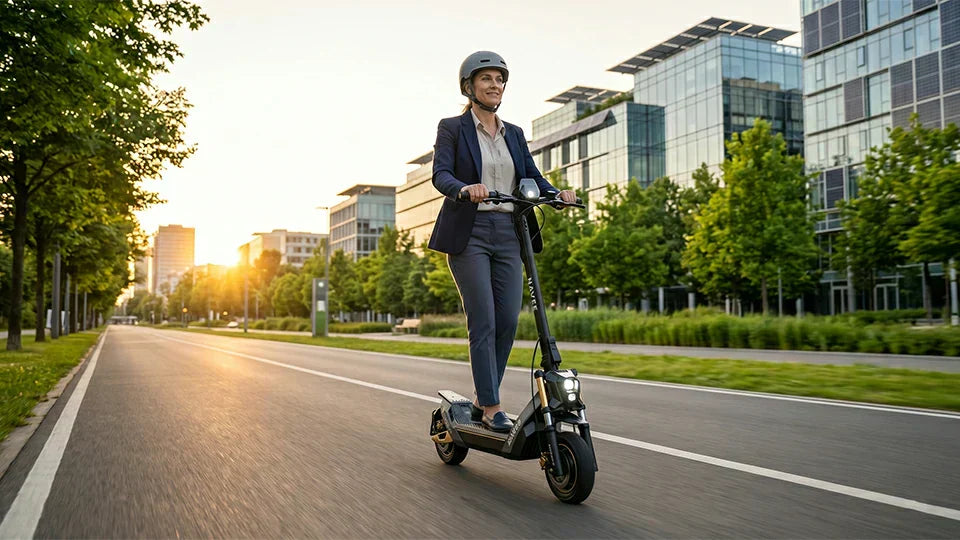
Buying an electric scooter online is not just possible — for most riders, it's the better option. Lower prices, a complete model lineup, and manufacturer-backed warranties make the official online store a stronger starting point than most retail shelves. The one exception: if you've never ridden before and want to feel the deck under your feet first, a quick dealer visit handles that — and you still order online afterward. Here's how the whole process works.
Online promotions consistently run deeper than in-store deals. Sale prices on NAVEE Online official website apply directly, without a distributor margin or retailer markup sitting between you and the manufacturer. Physical stores carry those overhead layers regardless — floor space, staff, and distribution costs that don't disappear when the sticker price holds steady. When a promotion runs, the online price is the better deal.
Selection is the second advantage. A retail floor might carry three or four models, chosen around display space and margin. Navee's full lineup — from the GT3 at $499 to the UT5 Ultra X at $2,499 — is available at Navee product collections, with every color and configuration in stock. You are not working around someone else's inventory decision.
The third factor is who stands behind your purchase. Ordering through an official or authorized channel connects you directly to the manufacturer's customer service and warranty structure, not to a third-party seller who may interpret the return policy differently each time. For a purchase anywhere in the $500–$2,500 range, that distinction matters more than it does for most things bought online.
For context on what each price tier actually delivers, see how much electric scooters cost.
Two things are worth confirming before checkout: whether the scooter carries a real safety certification, and whether its advertised range actually covers your commute. Both take under ten minutes.
UL 2272 certifies the entire electrical system — battery, motor, wiring, and charger — as a unit. UL 2849 covers only the battery and charger. Both certifications matter, but UL 2272 is the one that satisfies the building requirements now enforced by apartment complexes and office buildings in cities like New York and Los Angeles. A scooter without it may ride fine outdoors but be legally barred from the indoor charging you actually need.
Verifying certification takes one step: go to iq.ul.com, enter the model name or certification number listed on the product page, and confirm the listing is active and current. If a seller cannot provide a certification number, that is a disqualifying answer — not a reason to keep asking.
Manufacturers measure range under controlled conditions: a 165-lb rider, flat pavement, eco mode, no headwind. Real-world riding — mixed terrain, normal cruising speed, a heavier rider — typically delivers around 70% of the stated figure. A scooter listed at 37 miles realistically covers about 26 miles per charge in daily use.
The formula for sizing correctly: take your round-trip commute distance, add 20% buffer for hills and stops, and that is the minimum real-world range you need. A 10-mile each-way commute requires at least 24 miles of usable range, which means looking for a scooter rated at 34 miles or more on the spec sheet. For how battery capacity changes over hundreds of charge cycles, see how long e-scooter batteries last.

Some riders want to feel a scooter before committing. That's a reasonable instinct — and it doesn't mean buying in store.
Navee has dealer locations across the U.S. where you can ride before purchasing. Use the Dealer Locator to find the nearest showroom with physical inventory. When you visit, focus on three things only: how the brakes respond when pressed firmly at around 10 mph, whether the suspension absorbs a curb drop without sending the impact into your wrists, and whether the deck width feels stable under both feet at a natural stance. Those are the variables a spec sheet cannot convey.
Everything else — price, configuration, warranty, color — is identical whether you buy in store or online. After a test ride, ordering through Online official website puts you back on the official pricing and full service track.
Most Navee orders ship within 1–3 business days and arrive within 5–10 business days depending on location. The packaging is large — plan for a delivery that needs a clear entryway or a first-floor hand-off.
Assembly takes 15–30 minutes on most models. The handlebar stem attaches and locks into the vertical tube, and the front fender occasionally needs one bracket screw tightened. A 4mm and 5mm hex wrench covers everything. The folding mechanism is assembled at the factory, so that step is already done.
One habit worth building before you open the box: photograph all four sides of the packaging first. A 30-second documentation step is the evidence that supports any freight damage claim if the scooter arrives with a bent stem or a cracked fender panel. Without it, the burden of proof falls entirely on you.
Navee's return window is 30 days from the date you confirm receipt. If the box has never been opened, you receive a full refund and pay only return shipping. If you've ridden it and encountered a quality defect, Navee covers all return costs and refunds in full. If you've ridden it and simply changed your mind, the refund applies minus a 10% handling fee, with return shipping on you.
These distinctions are worth knowing before checkout, not after. The full 30-day return policy details every condition, including how to obtain return authorization — a required step before shipping anything back.
On warranty: the main unit — frame, motor, controller, suspension assembly, and folding mechanism — carries a 24-month warranty. The battery and lighting components carry 12 months. Both apply only to purchases made through official or authorized channels. Buying from an unauthorized third-party marketplace seller means no warranty backstop, regardless of what the listing says. The complete coverage terms are at Navee's warranty page.
Before checkout, spend two minutes confirming your local rules. U.S. regulations vary more than most buyers expect — California requires a helmet for all riders, and several cities cap motor power at 750W for street-legal operation. A quick check of U.S. e-scooter regulations by state covers the major jurisdictions and what each one actually enforces at the curb.

Contact Navee customer service before attempting any repairs or riding the scooter. Photograph the damage alongside the original packaging — carriers require both to process a freight claim. If the damage affects the frame or electrical system, Navee will coordinate a replacement unit. Do not discard the box until the issue is resolved; it is part of the claim documentation.
Yes. Navee's online store offers installment payment options at checkout through third-party financing partners. The specific plans and eligibility terms vary, so check the payment page at checkout for current options. Financing is only available through the official store — third-party marketplace listings do not carry the same checkout options.
Navee does not require product registration to activate the warranty — your order confirmation serves as proof of purchase. That said, keeping a copy of your order number and purchase date is useful if you ever need warranty service. Some U.S. cities do require rider registration or licensing for street use; check your local rules before your first ride.
For electric scooters specifically, yes — with one caveat. Amazon's own inventory ("Ships from and sold by Amazon") is generally reliable. The risk comes from third-party sellers on the Amazon marketplace who may list the same model name but ship uncertified units or older stock. Buying from the Official website removes that variable: you are ordering factory-direct, and the 24-month warranty applies from day one.
Use the Dealer Locator to find the nearest showroom, then call or email ahead to confirm the specific model is on the floor. Dealer inventory rotates, and not every location carries every model. If the nearest dealer doesn't have your model, a test ride on a comparable model in the same weight class tells you most of what you need to know about deck feel and braking response.
Online works — for most riders, reliably — when the process follows a short sequence. Confirm the UL certification against the manufacturer's database. Run the range math against your actual commute distance. If you want a physical test, use a dealer location once and then order online for the full warranty and pricing. Photograph the box on arrival. Read the return and warranty terms before you need them.
The riders who end up frustrated after an online purchase almost always skipped one of those steps. The ones who follow through tend to find it simpler than buying a laptop. The scooter shows up in under two weeks, needs 20 minutes of assembly, and the first ride happens on a Tuesday morning before anyone else is out of bed.
Share:
Can You Recommend Electric Scooters Suitable for Long-Distance Travel?
Moped vs. Electric Scooter: Which Is Better for Daily Commuting?