


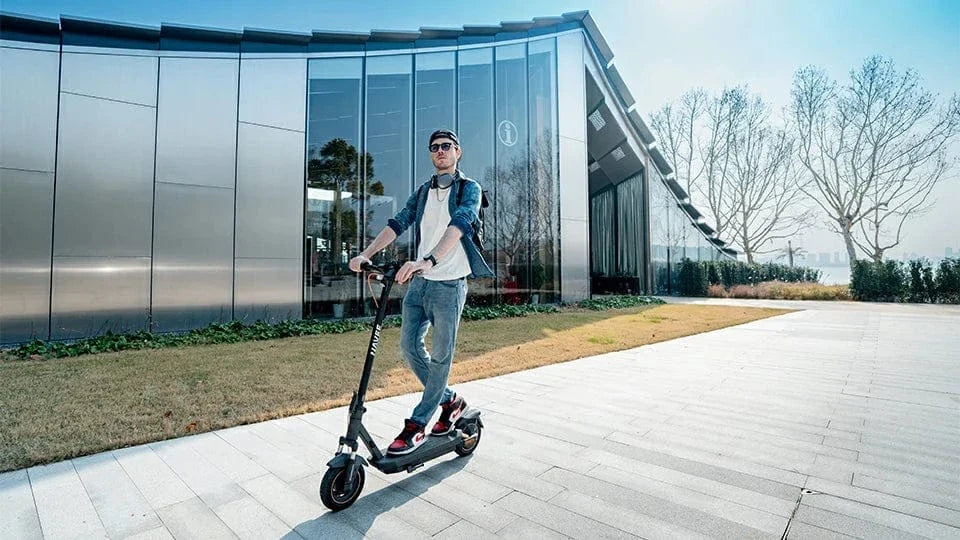
The best foldable electric scooter should suit your route and fit your life between rides. Carrying it upstairs, storing it beside a desk, and loading it into a trunk all place different demands on its weight and folding design.
The NAVEE V40i, V25 Pro, ST3 Pro, and GT3 Max address four priorities: short trips, compact storage, ride comfort, and longer commutes.
NAVEE Foldable Scooters at a Glance
Folded dimensions are length × width × height. Range figures reflect model-specific test conditions, not guaranteed commuting distances. Speed, rider weight, hills, temperature, and tire pressure affect actual range. Figures measured under different conditions are not directly comparable.

Best NAVEE Scooters by Commuting Need
Best for Short Commutes: NAVEE V40i
The NAVEE V40i suits short daily journeys that call for less carrying weight than the ST3 Pro or GT3 Max. It weighs 39 pounds and combines 10-inch pneumatic tires with up to 700W of peak motor power and a maximum range of 25 miles under test conditions.
The air-filled tires provide cushioning for everyday paved routes, while handlebar turn signals help communicate turning intentions. The tradeoff is carrying effort: a few steps into an office may be manageable, but repeated stair climbs require a realistic lifting assessment.
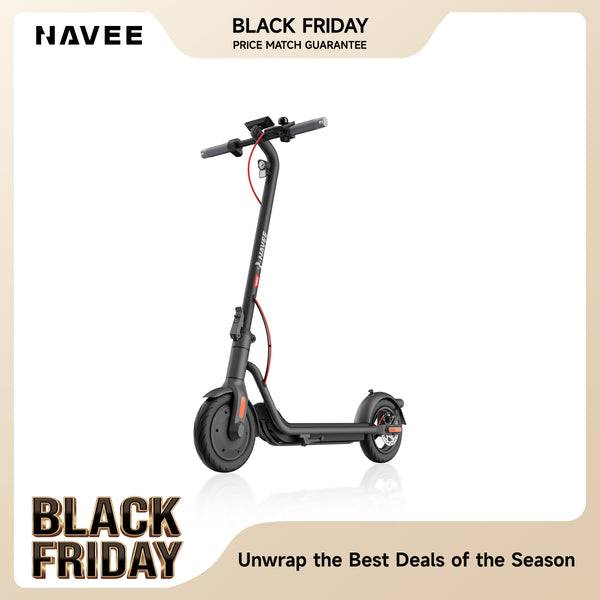
Best for Compact Storage: NAVEE V25 Pro
The NAVEE V25 Pro addresses a common storage problem: a folded stem can leave the handlebar sticking out across a narrow space. Its rotatable handlebar adds another way to reduce bulk after folding.
At 37 pounds, it weighs less than the other three models. Its 10-inch tires and maximum range of 15.5 miles under test conditions suit brief commutes where storage convenience takes priority over distance between charges.
Check the complete folded dimensions against your closet, trunk, or under-desk space. The rotating handlebar improves the storage profile, but does not guarantee a fit.
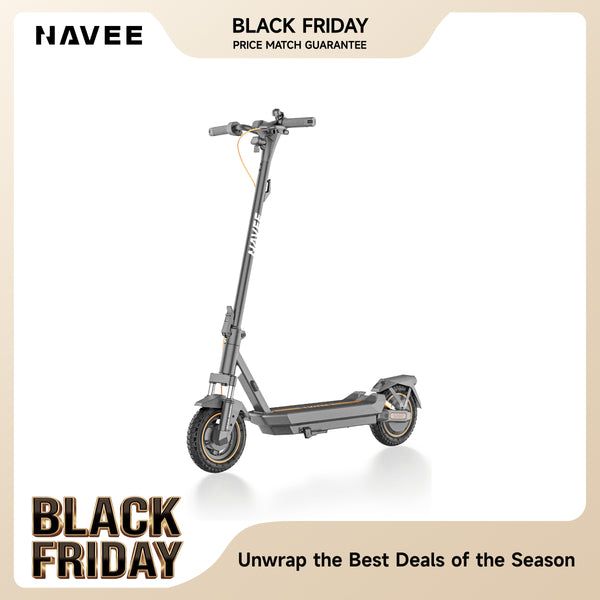
Best for Ride Comfort: NAVEE ST3 Pro
The NAVEE ST3 Pro suits commuters who prioritize suspension, tires, and braking equipment over low carrying weight. Dual Damping Arm suspension works with 10-inch self-sealing tubeless tires to cushion everyday road vibration. Braking combines a front drum brake, rear disc brake, and electronic braking.
Range reaches up to 46.6 miles at 9 mph or 28 miles at 20 mph under test conditions.
At 55.8 pounds, the ST3 Pro favors accessible storage and occasional lifting. Its folded footprint is approximately 47.2 × 23.6 × 23.5 inches, and a full charge takes about 10 hours.
An elevator, garage, or ground-level storage area makes this weight easier to accommodate.
Best for Longer Commutes: NAVEE GT3 Max
The NAVEE GT3 Max suits longer commutes where both range and folded size matter. It reaches up to 46.6 miles at 9 mph or 25 miles at 20 mph under test conditions.
Front fork and rear cylinder suspension, together with 10-inch tubeless tires, help cushion longer rides. Its 50.7-pound weight is 5.1 pounds lower than the ST3 Pro, and the folded dimensions are approximately 46.5 × 23.2 × 21.3 inches.
Compared with the ST3 Pro, it trades some range at 20 mph for lower weight and a smaller folded footprint.
A full charge takes approximately 10 hours, so it is best suited to a routine with a long enough charging window.
How to Choose a Foldable Scooter
Carrying Weight and Folded Size
Start with the hardest lift you will repeat regularly. Consider stairs, carrying distance, and anything else you bring, including a laptop bag or groceries. If possible, try lifting the scooter before buying.
For storage, measure:
- The available length, width, and height.
- The trunk opening, closet doorway, or other access point.
- Extra clearance needed to move the scooter in and out.
Folding reduces bulk, not weight. A scooter can fit a trunk and still be awkward to lift into it.
Folding and Locking Mechanism
Check how the stem folds, how it stays folded during handling, and how the riding latch locks into place. A rotating handlebar can help with storage, but adds another mechanism to secure before riding.
Follow the model-specific instructions and use the approved lifting points. Unexpected movement, damage, or a latch that will not engage properly needs attention before the next trip.
Range and Charging Time
Calculate the full journey between reliable charging opportunities, including the return trip and likely detours. Leave a reserve for headwinds, hills, and colder conditions.
Use range figures measured at speeds and loads close to your own. Low-speed maximums can substantially exceed the distance available during faster commuting.
Confirm access to a suitable charging location and enough time between rides. Workplace charging should only be part of the plan when it is available and permitted.
Hill Performance and Rider Capacity
Count the rider and carried belongings together when checking maximum load. The V25 Pro supports up to 220 pounds; the ST3 Pro and GT3 Max each support up to 265 pounds.
Peak motor wattage alone does not predict hill performance. Rider load, slope length, battery charge, and the drive system all matter. A maximum incline figure also needs its test conditions to be meaningful.
Tires, Suspension, and Brakes
Match these features to the surfaces you ride most often:
- Pneumatic tires provide cushioning but need regular pressure checks.
- Self-sealing tubeless tires help with certain punctures but are not maintenance-free.
- Front and rear suspension can improve comfort on uneven pavement, particularly over longer trips.
Brake equipment is only part of stopping performance. Grip, speed, load, and technique also matter. Practice controlled braking in a clear area before joining traffic.

FAQ
Does a foldable scooter mean easy carrying?
No. Folding reduces bulk, while weight, balance, and lifting points determine carrying effort. A model that is manageable for an occasional trunk lift may still be impractical for several flights of stairs every day.
How much range do you need for commuting?
An 8-mile round trip needs more than an 8-mile maximum under test conditions. Allow extra capacity for detours, hills, and changes in weather, using the range figure closest to your normal riding speed.
Can you take a foldable scooter on public transit?
Check the current policy for the specific operator and service. Folding alone does not guarantee permission. For example, NJ TRANSIT's personal electric vehicle policy requires devices to remain powered off on its vehicles and property and prohibits charging on services and at specified facilities. Check size, placement, and travel-time restrictions before planning a scooter-and-transit commute.
Share:
Best 20 MPH Electric Scooters for Adults: NAVEE Guide