


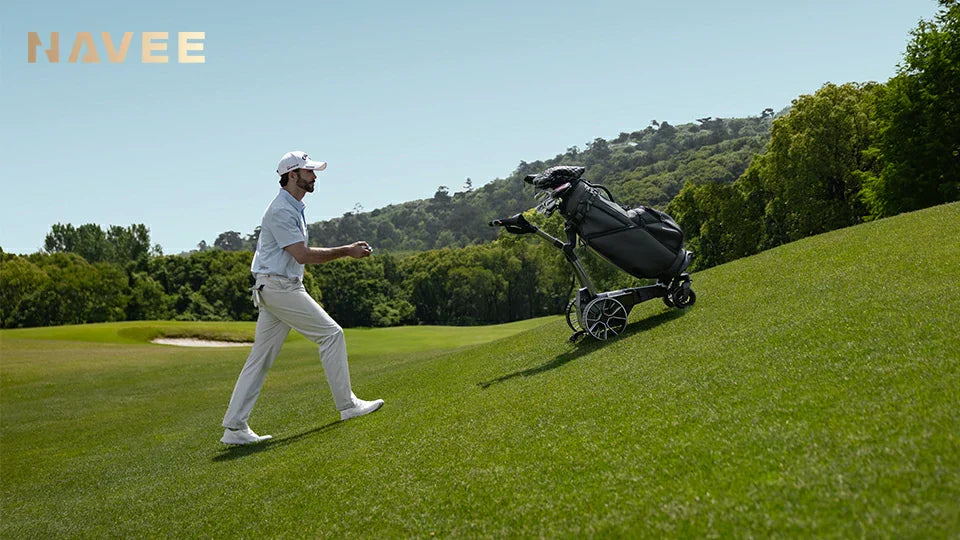
What's the best electric golf push cart in 2026? After weighing this year's top models against five criteria — battery endurance, control precision, slope stability, transport and folding, and after-sale support — our answer comes down to this: for most golfers, the cart worth the money offers both remote control and follow mode, runs a 36-hole lithium battery, and folds small enough for a real trunk. The NAVEE Birdie 3X is our 2026 pick because it delivers all three at a price that undercuts much of the premium follow-mode competition.
The honest answer is that the right cart depends on your course, your car, and how you like to walk — and a spec sheet won't tell you whether a cart dies on hole 15 or tips on a side slope. This guide will. Below, you'll see exactly how we judge every cart, how to read battery ratings the way manufacturers won't explain them, which features earn their price, and a six-point course test you can run yourself before trusting any cart with your clubs.
How We Pick And Test Electric Golf Push Carts?
A "best of" claim is only as good as the method behind it, so here's ours. At NAVEE, every cart we look at gets judged on the same five things:
- Battery endurance. Rated for at least 27 holes, ideally 36 — and judged on how that rating holds up with a loaded bag on real terrain, not in a brochure.
- Control precision. How smoothly the remote, follow mode, and cruise control behave where it matters most: tight spots and green surrounds, not just open fairways.
- Slope stability. Climbing power, downhill manners, and grip on side slopes and wet morning grass.
- Transport and folding. How fast it folds, how small it gets, and whether one person can comfortably lift it into a sedan trunk.
- Support after the sale. Warranty terms, service access, and whether you can still buy a replacement battery three years from now.
Just as important: anything we recommend has to clear the same six-point course test you'll find later in this guide — the exact checks you can repeat yourself during a demo or a return window. If a cart can't pass on a real course, it doesn't get our recommendation, no matter what the spec sheet says.
Prefer to start from a ranked list? Our top 8 electric golf caddies for 2026 covers that. This guide is the method underneath it.

What Does Battery Life Really Mean On The Course?
Battery life is the spec that shapes everything else. Get it right, and you'll barely think about it again. Get it wrong, and you're pushing a 35-pound dead cart up the eighteenth.
How To Read 18, 27, And 36-Hole Ratings?
Here's the thing about hole ratings: they're a ceiling, not a promise. A "36-hole" battery means 36 holes in friendly conditions — mild weather, gentle terrain, an average bag. It's like a car's advertised gas mileage. Close, but you'll rarely hit it.
So use this simple rule: buy one tier above your longest normal day.
- Flat course, and you charge after every round? 18–27 holes is plenty.
- Hilly course, occasional 36-hole days, or you sometimes forget the charger? Go straight to 36.
6 Things That Drain Your Battery Faster
- Hills. Climbing is usually the single biggest drain on your charge. On a hilly course, mentally turn a 36-hole rating into 27.
- A heavy bag. The motor moves everything you load on — rain gear, extra balls, the cooler pocket.
- Running top speed all day. A steady, moderate pace is far more efficient.
- Cold mornings. Lithium batteries read lower in cold weather. That's normal.
- Wet or thick grass. Soft ground means more rolling resistance.
- Battery age. Every battery fades a little each year. Your habits decide how fast.
5 Habits That Make Your Battery Last For Years
- Charge after every round. Lots of shallow charges beat a few deep ones.
- Never store it empty. For winter breaks, store at about 50–70% and top up once a month.
- Keep it out of hot cars. Heat ages a lithium battery faster than almost anything else. Bring it inside.
- Wipe the contacts now and then. Dirty terminals act like a weak battery.
- Don't fear partial charges. Lithium has no memory effect — topping up early doesn't hurt it — so charging before a quick nine is fine.
Tip: A quality lithium pack is typically rated for 1,000+ charges. Follow these habits and your battery costs you pennies per round over its life.
Which Features Are Worth Paying For?
Feature lists are where prices stretch from under $1,000 to over $2,000. Here's how to separate the features that change your round from the ones that just change the brochure.
Remote, Follow, Or Power-Assist: How To Decide
Ask yourself three questions, in order:
- Is pushing effort your only complaint? A power-assist motorized golf push cart is enough. You steer, the motor does the work.
- Do you want to send the cart ahead or park it precisely off the green? You want remote control.
- Do you want completely hands-free walking on open fairways? That's follow mode — the closest thing to a human caddie.
Here's how the three compare at a glance:
| Control Mode | How It Works | Best For | Price Tier |
|---|---|---|---|
| Power-Assist | Motor does the pushing, you steer from the handle | Flat courses; golfers who just want zero pushing effort | $ |
| Remote Control | You drive the cart from a handheld, up to 100 yards away | Precise parking near greens; sending the cart to the next tee | $$ |
| Follow Mode | The cart tracks you and trails behind automatically | Open fairways; fully hands-free walking | $$$ |
Now, here's something most guides won't tell you: many owners change their minds after buying. Plenty of golfers who buy for follow mode end up using remote control near greens, where precise placement wins. That's why a cart that does both is the safer bet. The NAVEE Birdie 3X, for example, combines Smart Follow-Me mode, a 100-yard remote, and cruise control — so your real preference can show up over your first few rounds instead of being locked in at checkout.
Stability Features You Need On Hills
If your course has real slopes, these aren't extras. They're the product:
- Dual motors for climbing without strain. The Birdie 3X runs dual 800W brushless motors for exactly this.
- Downhill speed control, so the cart holds a steady pace on descents instead of running away.
- A wide wheel stance. Width and a low center of gravity help keep a loaded cart planted on side slopes — the 3X's 4+1 wheel layout (four wheels plus an extra rear wheel for anti-tip support) is built around it.
- Treaded wheels that grip wet morning grass.
Nice To Have, Not Need To Have
GPS screens, phone apps, USB ports, fancy consoles — all genuinely pleasant, all optional. Pay for them if you'll use them. Just don't let them push you up a price tier when what you really needed was a bigger battery or better stability.
How To Choose The Best Electric Golf Push Cart: 5 Simple Steps
Ready to decide? Work through these steps in order and you're unlikely to go far wrong.
Step 1 — Look At Your Course First. Flat course? A simpler, lighter cart works. Hilly course? Dual motors and stability features move to the top of your list.
Step 2 — Size The Battery. Take your longest regular day, then buy one rating tier above it. Hilly course? Add another tier.
Step 3 — Pick Your Control Mode. Use the three questions above. If you're torn, choose a cart that offers both remote and follow.
Step 4 — Do The Trunk Test. Check the folded size and weight against your actual car. A cart you struggle to lift is a cart you'll probably stop using.
Step 5 — Set Your Budget Last. Spend on motors, battery, and stability first. Treat screens and apps as extras, not requirements. And before you pay, check the warranty terms and how easy it is to buy a replacement battery.

The 6-Point Course Test You Can Run Yourself
Steps done? Good. Now make the cart prove it. Spec sheets are written on flat ground — so whether you're demoing a cart or shaking down a new one inside its return window, run these six checks in a single round:
- The Climb Test. Take the steepest hill on your course, fully loaded. Pass: the cart climbs at the same pace it cruises, with no motor whine.
- The Descent Test. Same hill, going down. Pass: the cart holds its speed and never freewheels away from you.
- The Side-Slope Hold. Cross a green-side slope at walking pace. Pass: no wheel lift, no drifting off your line.
- The Wet-Grass Run. Catch the morning dew. Pass: no wheel slip at take-off, tracking stays straight.
- The Range Audit. Check the battery gauge at holes 6, 12, and 18 with your own bag. Pass: you're on pace to meet the rating.
- The Fold-And-Trunk Test. Time the fold, then lift the cart into your trunk with your clubs already in. Pass: one easy motion, and it genuinely fits.
Any electric golf trolley worth considering should clear all six. It's the checklist the Birdie 3X was designed around — dual motors for the climbs, a wide 4+1 stance for slopes and wet grass, a 36-hole battery for the range audit, and a 3-second fold for the trunk.
Your First Three Rounds: What To Expect
Round one is about trust. Almost every new owner spends the front nine convinced the cart will tip or wander off — and the back nine wondering why they worried. Start in manual or assist mode, and try follow mode on open fairways first, not beside greens.
Round two is remote practice. Send the cart ahead to the next tee while you putt out. Park it on slopes with the brake set. Small thumb inputs beat big ones.
Round three is when your rhythm appears. Most golfers settle into follow or cruise on long open holes and remote control around greens. Lock in your charging ritual the same week: clubs in the trunk, battery on the charger, every time.
One etiquette note while you're learning: keep the cart off greens and tee boxes, and mind your pace. The novelty wears off in a round — the courtesy shouldn't.
FAQs
1. Should I Buy An 18-Hole Or 36-Hole Battery?
Match the rating to your longest regular day, then buy one tier up. If you play single rounds on a flat course and charge faithfully, 18–27 holes is enough. If your course is hilly, you play 36-hole days, or you forget chargers, 36 holes all but removes the worry.
2. Are Electric Golf Push Carts Allowed On Every Course?
The large majority of courses welcome them. A small number of private clubs limit remote or follow operation, so if you're playing somewhere new, one quick call to the pro shop settles it before you load the car.
3. What's The Difference Between Remote Control And Follow Mode?
Remote control means you drive the cart from a handheld — great for sending it ahead or parking it precisely. Follow mode means the cart trails you automatically, hands-free. Many golfers use both in the same round: follow on open fairways, remote around the greens. A cart with both keeps your options open.
4. Is An Electric Push Cart Worth It Over A Manual One?
If you play flat courses, travel light, and finish rounds fresh, a manual cart serves you fine. The electric upgrade earns its price when hills, long days, or back and shoulder strain start costing you energy — and strokes — on the closing holes.
Final Thoughts
Finding the best electric golf push cart isn't about chasing the longest feature list. It's three decisions done in the right order: size the battery to your longest day, match the features to your terrain, and prove it all with the six-point course test.
If you want an electric golf caddy already built around those checks, take a closer look at the Birdie 3X's full specs.
Share:
Are There Smart Locks Available for Electric Scooters?
Are There Universal Chargers Compatible With Most E-Scooters?