


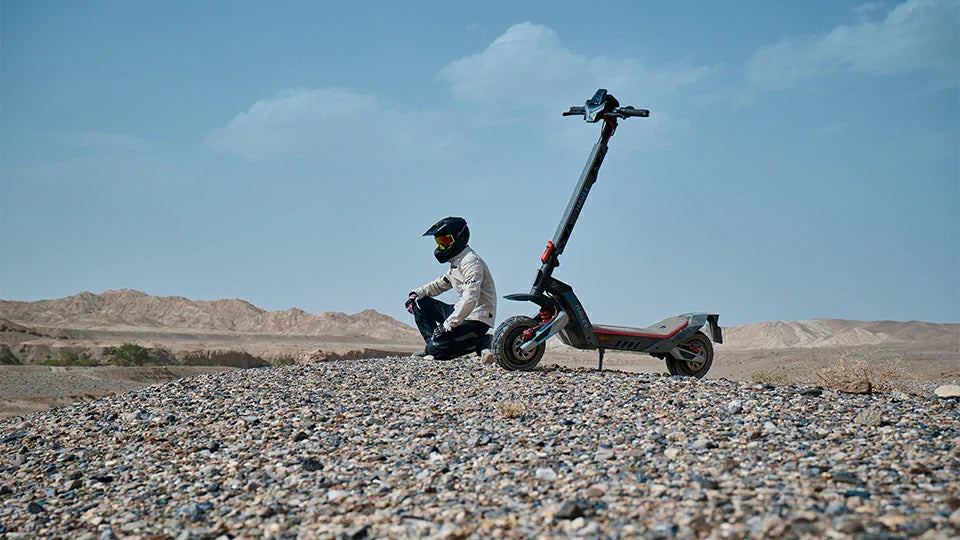
To immediately maximize your E-Scooter Range, you must minimize invisible friction and energy waste. The most effective methods are: inflate your pneumatic tires to the maximum recommended PSI (usually 45-50) to lower rolling resistance, use a manual "Kick-Start" to 3mph to avoid high-amp acceleration spikes, cap your speed at 15mph to reduce wind drag, and adjust your regenerative braking settings to match your specific terrain.
While those are the quick answers, the difference between getting stranded and making it home lies in understanding why your battery drains faster than expected.
There is a specific kind of anxiety that every electric scooter rider knows. You’re three miles from home, the battery bar just turned red, and you’re doing the mental math: "Will I make it, or am I about to push this 40-pound dead weight the rest of the way?"
We call this Range Anxiety, and it is the NO.1 pain point for riders worldwide. You might wonder why your scooter—advertised with a 30-mile range—sometimes only gives you 18 miles. Is the battery broken? Did you buy a defective unit?
The answer is likely no. Most "Range Loss" is caused by physics—specifically rolling resistance and aerodynamic drag—not a dying battery. The advertised specs are tested in a lab, but you ride in the real world. The good news is that by hacking your riding style and maintenance routine, you can recover those lost miles. Here are the 5 Essential Tips to help you beat the specs.
Tip 1: Tire Pressure is Your "Free" Range Booster
If you only do one thing from this list, make it this. Under-inflated tires are the silent killer of E-Scooter Range.
It is a matter of simple physics. When your tire pressure is low, the tire "squishes" against the ground. This increases the "contact patch" (the amount of rubber touching the road). While a large contact patch is good for grip, it creates massive rolling resistance. Your motor has to work 20% to 30% harder just to push the tire forward, draining your battery silently with every rotation.
This is exactly why the Navee XT5 Pro is equipped with massive 12-inch all-terrain tires engineered for low rolling resistance. Their advanced design naturally helps extend range by reducing energy loss, but remember: even the best engineering needs the right air pressure to perform at its peak.
The "45 PSI" Rule
Most riders assume "if it’s not flat, it’s fine." This is wrong. Pneumatic (air-filled) tires are slightly permeable; they naturally lose a tiny amount of air over time. A tire that looks full can easily be 10 PSI under-inflated, which is enough to kill your mileage.
-
Actionable Step: Buy a portable digital pump and check your tire pressure once a week.
-
The Target (Dry Conditions): For most commuter scooters, keep your tires inflated to the maximum PSI recommended on the sidewall (typically 45–50 PSI).
-
The Result: Higher pressure means a harder tire, less friction, and significantly more efficient rolling. It can instantly add 2–3 miles to your trip without you doing anything else.
Important Safety Exception: While maximum pressure is best for range, it reduces your tire's contact patch (grip). If you are riding in rain, on wet leaves, or on icy winter roads, do NOT use max pressure. Instead, lower your pressure by 3–5 PSI. This softens the tire and increases the surface area touching the road, giving you essential traction. In slippery conditions, always prioritize safety over efficiency.
Tip 2: Diagnose "Silent Drag" with the Spin Test
Have you ever felt like your scooter is "holding back," even when you let off the brake? Or maybe you hit the throttle, and it feels sluggish? You might be fighting against your own mechanical disc brakes.
Disc brake calipers are sensitive. They can easily get knocked out of alignment by a bump, a pothole, or even just folding the scooter roughly. When this happens, the brake pad lightly drags against the metal rotor while you ride. It’s not enough to stop you, but it acts like a constant 10% brake force, fighting the motor and eating away your battery life.
How to Perform the "Spin Test"
You don't need to be a professional mechanic to diagnose this. You just need a chair.
-
Actionable Step 1: Lift your scooter onto a box or chair so the wheels are freely suspended off the ground.
-
Actionable Step 2: Give each wheel a hard spin with your hand.
-
The Diagnosis:
-
Good: The wheel spins silently and keeps spinning for 10–15 seconds.
-
Bad: The wheel stops abruptly after 2-3 seconds.
-
Very Bad: You hear a rhythmic hiss-hiss-hiss sound as it spins. This is the sound of your range dying.
How to Fix It (Safety First!)
If you confirm your brakes are rubbing, caution is required. Your brakes are your most important safety feature, and improper adjustment can lead to brake failure.
-
Recommended Option: Visit a Pro. We strongly recommend taking your scooter to a local bike shop or electric scooter service center. A professional can realign the calipers and check the pad wear in minutes. This ensures your brakes function correctly when you really need them.
-
For Experienced Mechanics Only: If you are confident in your mechanical skills, you can try the "Loosen-Squeeze-Tighten" method (loosen caliper bolts, squeeze lever to center, re-tighten). However, if you are unsure, do not risk it. A few saved miles are not worth compromising your safety.

Tip 3: Master the "Kick-Start" to Save the Spike
The single most energy-expensive moment for your scooter is accelerating from a dead stop.
In physics, "Static Friction" (the force needed to get a stationary object moving) is much higher than "Kinetic Friction" (the force needed to keep it moving). Electric motors draw a massive spike of current (Amps) to overcome this static inertia. If you mash the throttle from 0 mph, you create a huge heat spike in the controller and battery, wasting energy that could have been used for distance.
The "3 MPH" Technique
Stop treating your e-scooter like a drag racer. Instead, treat it like a manual kick scooter for the first 3 seconds.
-
The Mistake: Relying on the "Zero Start" feature (where the throttle works instantly from a standstill).
-
Actionable Step: Disable "Zero Start" in your app if possible. Even if you can't, make it a habit to never hit the throttle from a standstill.
-
The Routine: Always give the scooter two strong manual kicks to get it up to 3–4 mph before you engage the motor. Your leg muscles are free; battery power is expensive. By handling the hardest part of the launch yourself, you save the battery from that initial high-stress drain.
Tip 4: Understanding Drag: The "15 MPH Wall"
Speed kills... your battery. But it doesn’t happen linearly; it happens exponentially.
This is due to Aerodynamic Drag. The faster you go, the harder the air pushes back against you. Riding at 20 mph consumes nearly double the energy of riding at 15 mph. At higher speeds, your motor isn't fighting the road friction anymore; it is fighting the invisible wall of air in front of you.
The "Dimmer Switch" Throttle Method
Many riders treat the throttle like an On/Off switch—either 0% or 100%. This is inefficient because it constantly dumps maximum power into the motor.
-
Actionable Step: Use "Drive" (D) Mode instead of "Sport" (S) Mode. This naturally caps your speed at around 15-18 mph, which is the "Goldilocks Zone" for efficiency—fast enough to commute, but slow enough to avoid massive wind drag.
-
The "Tuck" Trick: If you are facing a strong headwind, don't just stand there like a sail.
-
Bend your knees slightly.
-
Bring your elbows in close to your body.
-
Crouch down.
-
Why? Reducing your frontal surface area can improve your E-Scooter Range by 10-15% on a windy day. Also, zip up your jacket! A loose, flapping coat creates "parasitic drag" (turbulence) behind you.
Tip 5: Strategic Regenerative Braking (City vs. Highway)
Regenerative braking (KERS) is a feature that turns your motor into a generator when you slow down, sending power back into the battery. Many riders logically think: "I should set this to High to get the most range."
This is often a myth.
Energy conversion is never 100% efficient. Converting motion into electricity (braking) and then converting electricity back into motion (accelerating) loses energy to heat. On long, flat, open roads, "High Regen" creates a "yo-yo effect." It slows you down too aggressively the moment you let off the throttle, forcing you to accelerate again to maintain speed.
When to Use Which Setting?
To truly maximize range, you need to adjust this setting based on your route—provided your specific scooter model offers this customization feature via an app.
-
Scenario A: City Riding (Stop-and-Go).
-
Setting: Medium or High.
-
Why: You are forced to stop at red lights and stop signs anyway. You might as well capture that energy rather than wasting it as heat in your mechanical brakes.
-
Scenario B: Long Commute (Suburban/Bike Paths).
-
Setting: Low or Off.
-
Why: Coasting is the most efficient state of travel. It costs zero energy to glide for 200 yards. If your regen is too strong, it kills your momentum, stealing that "free" glide distance.
Bonus: Environmental Factors That Steal Mileage
Sometimes, you can do everything right, and the range still drops. This is usually due to external factors. Understanding them prevents panic.
The Temperature Trap
Batteries hate the cold. In winter (below 40°F / 4°C), the internal resistance of the battery cells increases. This causes Voltage Sag, which can temporarily reduce your range by 30% to 50%.
-
The Fix: Never leave your scooter stored outside in the cold. Keep it inside at room temperature until the very moment you leave. A warm battery will maintain its efficiency for the first few miles, giving you a head start against the cold.
The Payload Penalty
E-scooters are sensitive to weight. A 200lb rider carrying a 20lb backpack uphill requires significantly more torque than a 150lb rider with no bag.
-
The Fix: You can't change your weight instantly, but you can change your route. Avoid steep hills if a slightly longer, flatter route is available. Climbing a steep grade drains the battery 5x faster than cruising on flat ground.

FAQs About E-Scooter Range
Q: Does rider weight really affect range that much?
A: Yes. Most manufacturer specs are tested with a rider weighing around 165 lbs (75 kg). For every 20 lbs over that limit, you can expect a roughly 5-10% reduction in range, especially if your route has hills.
Q: Will fast charging damage my battery and reduce range?
A: Generally, no, as long as you use the official charger. However, heat is the enemy. Avoid charging immediately after a long ride while the battery is still hot. Let it cool down for 30 minutes first to preserve long-term battery health.
Recommended Reading: Want to learn more about extending the overall lifespan of your battery (not just today's range)? Check out our full guide: How To Make Your Electric Scooter Battery Last Longer?
Q: Can I upgrade my battery for more range?
A: On most consumer scooters, the battery is sealed inside the deck and is not easily upgradeable. The best way to get more range is to optimize the 5 tips above. If you consistently need more miles, it is often more cost-effective to upgrade to a dedicated long-range model. For example, the Navee ST3 Pro is engineered with a high-efficiency 48V battery system specifically designed to deliver consistent power over long distances, which is safer and more reliable than modifying a commuter scooter.
Ready to Leave Range Anxiety Behind?
Optimizing your riding style and maintenance routine is the smartest way to squeeze every last mile out of your current setup. By mastering tire pressure, momentum, and throttle control, you can turn a stressful commute into a confident cruise.
However, physics has its limits. If you are following all these tips and still find yourself constantly checking the battery bar or charging mid-day, it might be time for an upgrade.
Don't let a small battery limit your freedom. Discover Navee’s lineup of Long-Range Electric Scooters designed specifically for the serious commuter. With high-capacity batteries, advanced energy recovery systems, and ultra-efficient pneumatic tires, our scooters are built to go the distance—so you never have to push home again.
Compartir:
The Ultimate Guide to Riding Electric Scooters in Winter: Challenges and Tips
Are Electric Scooters Waterproof?