


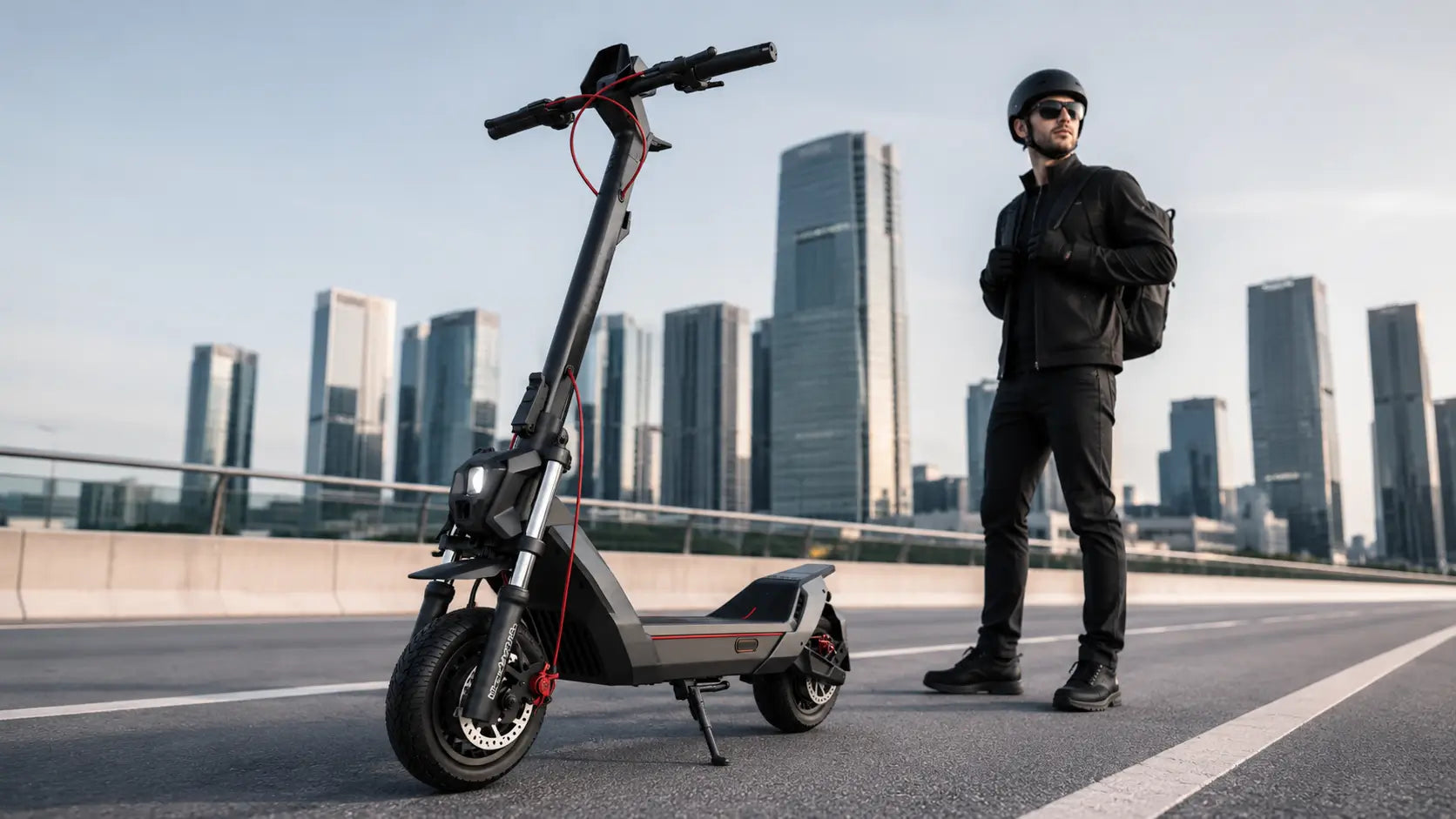
Al comprar un patinete eléctrico de alta velocidad y gran autonomía, las características más importantes son: la potencia del motor, la capacidad de la batería, el sistema de frenado, la suspensión, el tipo de neumáticos, la resistencia al agua y los modos de conducción inteligentes. Cada una afecta directamente a la velocidad, la autonomía y la seguridad. A continuación, te explicamos qué buscar en cada una.
Comparación rápida: qué buscar según el nivel de rendimiento
| Característica | Urbano | Gama media | Alto rendimiento |
|---|---|---|---|
| Motor | 350–500 W | 500–800 W | 800 W+ / Doble |
| Batería | ~360 Wh | ~576 Wh | 1.000 Wh+ |
| Velocidad máxima | 15–20 mph | 20–28 mph | 28–40+ mph |
| Autonomía | 15–25 mi | 25–40 mi | 40–60+ mi |
| Frenos | Electrónicos/de tambor | De disco | De disco hidráulico |
| Suspensión | Ninguna/Delantera | Delantera+Trasera | Doble avanzada |
| Neumáticos | Macizos de 8–9" | Neumáticos de 10" | Tubeless de 10–12" |
1. Potencia del motor: el motor detrás de la velocidad y la capacidad de ascenso
La potencia del motor determina la velocidad y la capacidad del patinete eléctrico para subir cuestas. Para desplazamientos urbanos generales, un motor con potencia nominal de 500 W es un mínimo razonable. Para un rendimiento de alta velocidad real o para usuarios más pesados, busca 700 W o más, con una potencia máxima superior a 1.200 W.
Presta atención tanto a la potencia nominal (continua) como a la potencia máxima. Un patinete eléctrico con potencia nominal de 700 W y máxima de 1.350 W —como el NAVEE ST3 Pro — ofrece una aceleración suave sin quemar el motor bajo una carga sostenida.
Los motores dobles merecen la pena si te encuentras con pendientes pronunciadas con frecuencia o necesitas tracción para todo tipo de clima.

2. Capacidad de la batería: la autonomía depende de los vatios-hora, no solo de los amperios-hora
Los fabricantes suelen anunciar la capacidad de la batería en amperios-hora (Ah), pero los vatios-hora (Wh) = voltaje × Ah son la verdadera medida del potencial de autonomía.
| Tamaño de la batería | Autonomía aproximada en condiciones reales |
|---|---|
| 36 V 10 Ah (360 Wh) | 15–22 millas |
| 48 V 12 Ah (576 Wh) | 25–35 millas |
| 52 V 20 Ah+ (1.040 Wh+) | 45–60+ millas |
Una regla importante: la autonomía real suele ser entre el 70 % y el 80 % de la cifra anunciada. Un patinete eléctrico que promete 50 millas probablemente ofrecerá entre 35 y 40 millas en condiciones de conducción cotidianas. Ten en cuenta tu peso, el terreno y la velocidad media al hacer la estimación.
3. Velocidad máxima frente a velocidad real
La mayoría de las ciudades de EE. UU. regulan los patinetes eléctricos a 20–25 mph en vías públicas. Los modelos de alta velocidad pueden alcanzar 30–40 mph o más, pero esas cifras se miden en condiciones ideales y con poco peso.
Una velocidad cotidiana realista en un patinete eléctrico de «40 mph» se acerca más a 28–33 mph una vez que se tienen en cuenta el terreno, la carga y la resistencia del viento. Para desplazamientos urbanos, un patinete eléctrico con una velocidad máxima de 25–32 mph te ofrece un margen significativo sin dejar de ser práctico.
4. Sistema de frenado: el control es imprescindible a alta velocidad
Cuanto más rápido conduzcas, más importantes serán tus frenos. Así se comparan los principales tipos:
-
Frenos electrónicos/de tambor — adecuados para patinetes eléctricos urbanos ligeros y de baja velocidad
-
Frenos de disco mecánicos — buena potencia de frenado para modelos de gama media
-
Frenos de disco hidráulicos — el estándar para patinetes eléctricos de alto rendimiento; se ajustan automáticamente, son más potentes y ofrecen un rendimiento más uniforme en condiciones de humedad
Busca frenos dobles (delanteros y traseros) como mínimo. El frenado regenerativo (E-ABS) debería ser estándar en cualquier patinete eléctrico de alta velocidad serio: recupera energía durante la deceleración, lo que aumenta aproximadamente entre un 3 % y un 10 % la autonomía efectiva y reduce el desgaste de los frenos. Los patinetes eléctricos NAVEE vienen equipados con E-ABS como característica principal, no como un añadido.
5. Suspensión: estabilidad, no solo comodidad
5. Suspensión: estabilidad, no solo comodidad A velocidades más altas, la suspensión deja de ser una característica de comodidad para convertirse en una de seguridad. Una suspensión deficiente provoca vibraciones en el manillar, reduce el control y causa fatiga en trayectos más largos.
Para un uso de alta velocidad y gran autonomía, prioriza la suspensión delantera y trasera, idealmente hidráulica o un sistema diseñado específicamente como Damping Arm™ de NAVEE. A diferencia de los muelles tradicionales, este sistema patentado utiliza brazos oscilantes dobles y materiales de polímero de alta densidad para convertir los impactos verticales en movimiento horizontal, reduciendo significativamente las vibraciones para una conducción más suave. Una suspensión de muelles por sí sola es aceptable para vías urbanas lisas; los terrenos más accidentados exigen más.
6. Neumáticos: tu único contacto con la carretera
La elección de los neumáticos afecta al agarre, la resistencia a los pinchazos y la calidad de conducción a alta velocidad:
-
Neumáticos macizos — cero pinchazos, pero absorción deficiente de los impactos; evítalos para conducir a alta velocidad
-
Neumáticos neumáticos (con aire) — mejor agarre y amortiguación; la opción adecuada para la mayoría de los usuarios
-
Neumáticos tubeless — gran agarre y fugas lentas y seguras en lugar de reventones; excelentes para altas velocidades
-
Neumáticos tubeless autorreparables — reparan automáticamente los pinchazos con una comodidad superior; la opción prémium definitiva a pesar del mayor coste.
Para patinetes eléctricos de gran autonomía y alta velocidad, los neumáticos neumáticos o tubeless de 10 pulgadas o más proporcionan la estabilidad y el agarre que necesitas. Por esta razón exacta, el NAVEE XT5 Pro utiliza neumáticos tubeless todoterreno de 12 pulgadas es la elección adecuada.
7. Clasificación de resistencia al agua
Los usuarios que recorren largas distancias inevitablemente se encontrarán con condiciones de humedad. Busca al menos IPX4 (resistente a salpicaduras desde cualquier dirección). Para desplazamientos serios en todo tipo de clima, IPX5 o IPX6 ofrece una mejor protección contra la lluvia y los charcos.
Evita conducir cualquier patinete eléctrico a través de agua profunda independientemente de su clasificación IPX — la resistencia al agua protege los componentes electrónicos, no todo el sistema de transmisión.
Si quieres saber exactamente qué puede soportar tu patinete bajo un aguacero, consulta nuestra guía, La verdad sobre los patinetes eléctricos y la resistencia al agua.

8. Características inteligentes y modos de conducción
Los patinetes eléctricos modernos de alto rendimiento ofrecen características que mejoran tanto la seguridad como la gestión de la autonomía:
-
Múltiples modos de conducción (Eco / Estándar / Deporte) te permiten intercambiar velocidad por eficiencia de la batería
-
Conectividad con la aplicación permite el seguimiento de trayectos, límites de velocidad, bloqueo antirrobo y actualizaciones de firmware
-
Faros delanteros y traseros LED brillantes son esenciales para conducir de forma segura al amanecer, al anochecer o de noche
Estas características no son extras de lujo: son herramientas que te ayudan a sacar más provecho del patinete eléctrico y a conducir de forma más segura.
Reflexiones finales
Elegir el patinete eléctrico de alta velocidad y gran autonomía adecuado significa equilibrar la potencia con la seguridad. Aunque un motor potente y una batería de gran capacidad ofrecen velocidad y autonomía, son los frenos hidráulicos, la suspensión avanzada y los neumáticos tubeless los que te mantienen seguro y cómodo. Prioriza estas características esenciales para encontrar un patinete rápido, fiable y duradero.
Preguntas frecuentes
¿Cuánto cuesta un patinete eléctrico de alta velocidad y gran autonomía?
Los modelos de gran autonomía de gama de entrada cuestan alrededor de 600–800 $. Los patinetes eléctricos de gama media con buena velocidad y una autonomía real de 30–40 millas suelen costar entre 900 y 1.500 $. Los modelos de alto rendimiento con motor doble y más de 50 millas de autonomía pueden costar entre 1.500 y más de 3.000 $. En la mayoría de los casos, pagar más te ofrece frenos, suspensión y mayor duración de la batería de forma significativa, no solo especificaciones infladas.
¿Cuánto tiempo se tarda en cargar un patinete eléctrico de gran autonomía?
La mayoría de los cargadores estándar tardan entre 6 y 10 horas en cargar por completo un paquete de baterías grande. Algunos modelos admiten carga rápida o configuraciones de doble cargador que reducen este tiempo a 3–5 horas. Si el tiempo de carga es importante para tu rutina, comprueba si el patinete eléctrico admite carga rápida antes de comprarlo.
¿Puedo conducir mi patinete eléctrico bajo la lluvia? ¿Qué clasificación IPX necesito?
Sí. Busca al menos IPX4 para lluvia ligera, o IPX5 a IPX6 para desplazamientos más intensos en todo tipo de clima. Sin embargo, ninguna clasificación IPX cubre la inmersión total. Evita los charcos profundos y los aguaceros intensos para proteger el sistema de transmisión, y limpia siempre tu patinete después de un trayecto bajo la lluvia.
¿Merecen la pena los motores dobles?
Sí, si sueles subir cuestas pronunciadas, transportar cargas pesadas o necesitas mejor tracción en condiciones de humedad. Para desplazamientos urbanos por zonas llanas, un motor individual potente suele ser suficiente.
Más información:¿Cómo varía la autonomía de los patinetes eléctricos según el modelo?
Compartir:
Las mejores patinetes eléctricos que alcanzan 30 mph: velocidad, seguridad y para quiénes son
¿Cómo bloquear un patinete eléctrico?