

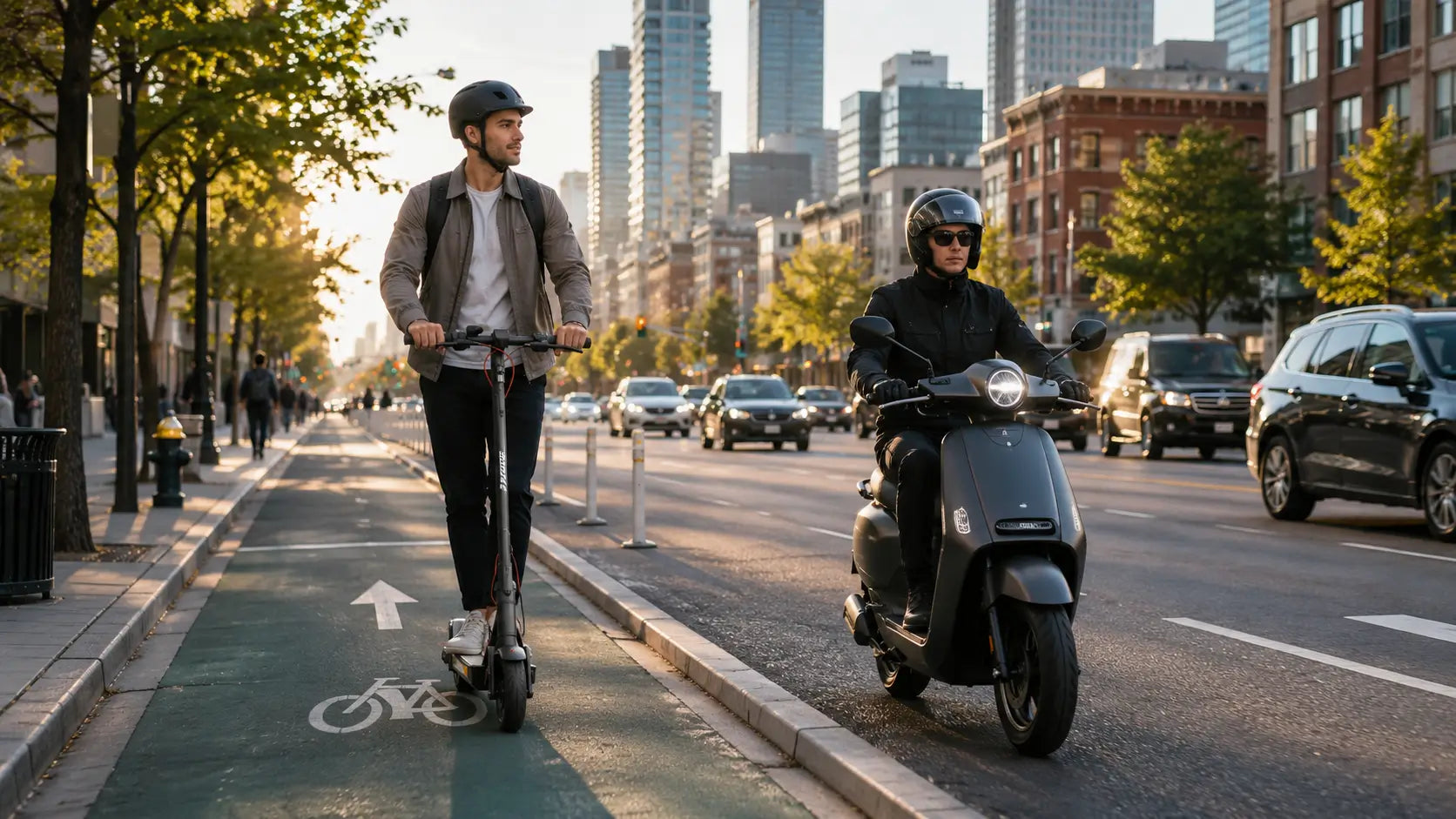
Choosing between a moped and an electric scooter comes down to your daily route. Mopeds deliver higher speeds, longer range, and built-in storage for longer suburban commutes. Electric scooters offer unmatched portability, zero registration fees, and lower costs, making them perfect for dense city streets.
Here is a direct comparison of speed, cost, and practicality to help you decide.
To keep things clear, we need to define exactly what we are comparing, because the terminology can get a little mixed up.
A Moped: Historically, a moped was a bicycle with a motor (motor + pedal). Today, the term is generally used to describe sit-down, step-through vehicles—like a Vespa. They are usually gas-powered (often a 50cc engine), though electric mopeds are becoming more common. They are street-legal vehicles built to ride alongside cars.
An Electric Scooter: When we say "electric scooter" in 2026, we are talking about a stand-up, kick-style scooter with a floorboard, two wheels, a stem, and a battery—like the models from NAVEE. Think of the ones you see in city bike lanes, ranging from lightweight commuter models to beefy, off-road versions.
| Feature | Moped (50cc or Electric Equivalent) | Stand-Up Electric Scooter |
|---|---|---|
| Riding Style | Sit-down | Stand-up |
| Top Speed | 30 – 40+ mph | 15 – 30 mph (on average) |
| Portability | Heavy (150+ lbs); park on the street | Lightweight (30–60 lbs); folds up |
| License/Registration | Required in most US states | Not required |
| Where to Ride | Traffic lanes | Bike lanes, local streets |
| Storage | Built-in trunk/under-seat storage | None (use a backpack) |
There is no one-size-fits-all answer here. The "better" choice depends entirely on how far you travel, the roads you take, and where you work.
Your commute is long: If you travel 10+ miles each way, sitting down is simply more comfortable.
You need to carry things: Mopeds have under-seat storage and racks for groceries, gym bags, or a passenger.
You ride in suburban traffic: If your route consists of 35-45 mph multi-lane roads without bike lanes, a moped gives you the speed and presence to flow with traffic safely.
You have a "last-mile" commute: If you live within 5 to 7 miles of your office, an e-scooter is unbeatable for weaving through city congestion.
You mix transit modes: E-scooters fold up, meaning you can take them on the subway, train, or bus. You can't do that with a moped.
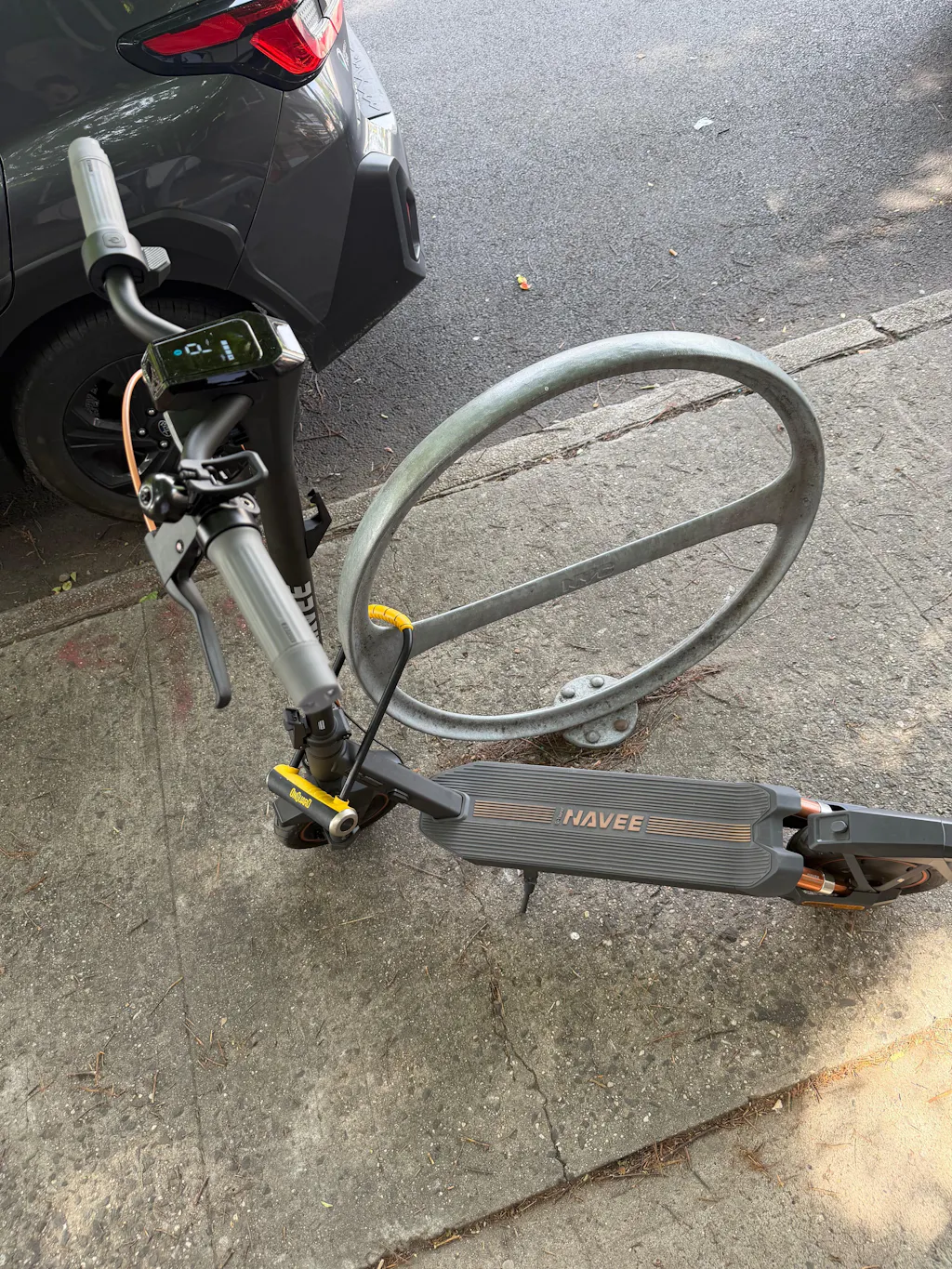
You don't have safe street parking: E-scooters can be folded and stored under your office desk or inside your apartment, effectively eliminating the risk of vehicle theft.
If you live and work in a dense, urban environment (like downtown Chicago, New York, or Seattle), the electric scooter wins. It allows you to utilize bike lanes, bypass traffic jams completely, and avoid parking hassles. If you live in sprawling suburbs (like parts of Texas or Florida), the moped is the safer, more practical choice.

Gas-powered mopeds are range monsters. A standard 50cc moped gets upward of 80 to 100 miles per gallon. You can ride for a week on a few dollars of gas. Their top speed usually caps out around 30 to 40 mph, which is perfect for local streets but legally bars them from highways.
Most commuter e-scooters top out between 10 and 20 mph, which is plenty fast for a bike lane. While their advertised range might say "up to 30 miles," real-world range (factoring in rider weight, hills, and wind) is usually closer to 15 to 20 miles per charge.
If you go the e-scooter route, always follow the 30% rule: buy a scooter with a real-world range that is at least 30% longer than your round-trip commute. This buffer ensures you won't be stuck pushing your scooter home if you face a strong headwind or decide to take a detour.
Electric Scooters: An electric scooter that reliably solves the "last mile" commuting problem typically costs between $200 and $600. If you need off-road or all-terrain riding, the price will increase accordingly as the vehicle configuration is upgraded.
Mopeds: A brand-new gas or electric moped will cost between $1,500 and $4,000+.
E-scooters run on pennies. Charging a standard electric scooter battery from 0% to 100% usually costs less than 10 cents on your electric bill. While gas mopeds are highly fuel-efficient, you still have to pay for gas, which adds up.
This is where electric scooters take a massive lead. Mopeds come with hidden costs: title fees, registration, monthly insurance premiums, and regular mechanical maintenance. E-scooters avoid almost all of this administrative red tape and associated costs.
Because they are classified as motor vehicles, mopeds are heavily regulated. In almost every US state, you need a valid driver's license (some states even require a specific motorcycle endorsement), liability insurance, a license plate, and yearly registration. You are also required to follow all standard motor vehicle traffic laws.
Electric scooters exist in a sweet spot of transportation law. In most cities, they are treated similarly to bicycles. You do not need a driver's license, insurance, or a license plate. You are generally required to ride in bike lanes rather than on the sidewalk, and while helmet laws vary by state for adults, wearing one is always strongly recommended.
If you buy a gas moped, you are buying an engine. That means oil changes, spark plug replacements, carburetor cleaning, and belt tensioning. Even electric mopeds require brake pad replacements and hydraulic fluid checks due to their heavy weight.
E-scooters are incredibly low maintenance. The motor is enclosed inside the wheel hub, so there are no belts or chains to grease. Your main maintenance tasks will simply be keeping the pneumatic tires properly inflated (to avoid flats and preserve battery range) and occasionally tightening the brakes.

Still on the fence? Run through this quick checklist:
Do I have a safe place to park outside? (If no, get an e-scooter).
Do I need to go faster than 20 mph to stay safe on my local roads? (If yes, get a moped).
Do I want to avoid paying for insurance and vehicle registration? (If yes, get an e-scooter).
Do I need to frequently carry a passenger or heavy groceries? (If yes, get a moped).
If your answers are pointing you toward the electric scooter life, your next step is finding a model that can actually handle the daily urban grind. You don't want a flimsy toy—you need a reliable daily driver.
If that sounds like what you're looking for, we highly recommend checking out the NAVEE City E-Scooter lineup. Designed specifically for daily commuters, these scooters hit the perfect sweet spot of portability, battery range, and ride comfort. Whether you're navigating tight bike lanes or folding it up to carry onto a train, they are built to make your daily trip to the office sweat-free and genuinely fun.
Swapping your car for two wheels will fundamentally change how you experience your city. You'll save money, reduce your carbon footprint, and actually start looking forward to your commute. If convenience, portability, and low costs are your top priorities, an electric scooter is the ultimate modern commuting tool. If you need distance, storage, and road presence, the moped remains a classic for a reason.
Yes. Most standard commuter electric scooters have a maximum payload capacity of 220 to 265 lbs (100–120 kg). If you exceed this limit, the scooter will struggle on hills, the brakes will wear out faster, and your battery range will drop significantly. Mopeds, with their heavier steel frames and robust suspension systems, typically have payload capacities of 300 to 400 lbs, making them the better choice for heavier riders or those riding with a passenger.
Most high-quality electric scooters come with an IP (Ingress Protection) rating, such as IP54 or IPX5, meaning they can handle light rain and puddles. However, they are not completely waterproof. Riding in heavy downpours can risk electrical damage and makes the roads dangerously slick for small tires.
Not exactly. Electric scooters are true zero-emission vehicles with incredibly small carbon footprints, making them one of the greenest ways to travel. Traditional gas mopeds burn fossil fuels and emit exhaust. While a 50cc 4-stroke moped is much better for the environment than a full-sized SUV, it still contributes to local air and noise pollution. (Of course, if you opt for a fully electric moped, you get the eco-friendly benefits of an e-scooter).
More reading:The Ultimate Guide: How To Ride An Electric Scooter For Beginners In 5 Easy Steps
Share:
Can You Buy an Electric Scooter Online? Here's Why It's the Smarter Way to Shop
Common Electric Scooter Problems and How to Fix Them