

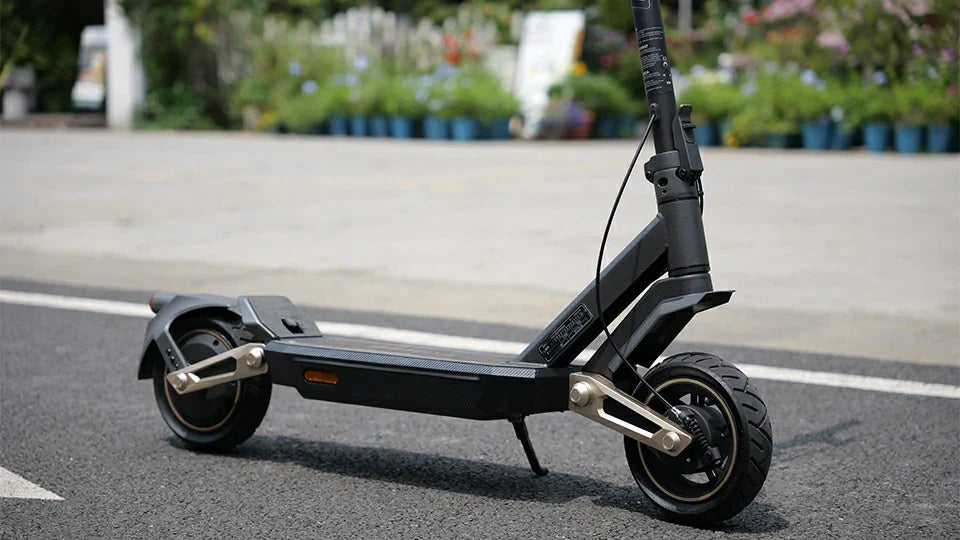
If you’re new to riding or just got your first e-scooter, understanding Electric Scooter Brakes is the best way to stay safe and ride confidently. Brakes are your main tool for control — they help you slow down smoothly, stop safely, and protect your scooter from wear.
This beginner-friendly guide explains everything: how brakes work, how to use them correctly, how to maintain them, and how to choose the right setup for your riding style.
Disc brakes: Use a caliper and rotor to create friction. They offer strong stopping power, precise control, and are ideal for daily riders.
Drum brakes: Enclosed in the wheel hub, they require little maintenance and are weather-resistant but cool more slowly.
Foot brakes: Pressed down with your heel; suitable only for basic or children’s scooters.
Tip: For most beginners, dual braking — combining mechanical (disc) and electronic systems — offers the safest and most balanced performance.
Electronic brakes use the motor to slow the wheel electrically. Regenerative braking goes a step further — it converts part of that energy back into your battery. It’s a smart efficiency boost, adding about 5–10% range, but it’s not strong enough to stop the scooter on its own. Always pair it with mechanical brakes for reliable control.
Modern scooters often feature a dual system, combining both mechanical and electronic braking. This shortens stopping distance, prevents wheel lock, and gives smoother control — especially for beginners who are still learning scooter braking technique.

When you press the brake lever, friction between the pads and the wheel converts motion into heat, slowing the scooter down. Clean pads and good tire grip keep that friction consistent, which means safer, shorter stops.
Think of it like this: smooth friction = stable control.
Balanced braking prevents skidding. The correct order is:
Pull the rear brake slightly first to stabilize the scooter.
Gradually squeeze the front brake to slow or stop completely.
Avoid pressing both levers hard or suddenly — this can cause the front wheel to lock.
Practicing smooth coordination builds confidence and control.
Start on flat, open ground.
Keep both feet flat, knees slightly bent.
Pull the rear brake first, then the front.
Keep your body upright and eyes ahead.
Gradually increase pressure until the scooter stops completely.
This technique keeps your center of gravity stable and helps you develop a natural braking rhythm.
Stay calm and shift your weight backward.
Apply both brakes gradually — never yank the levers.
Keep your arms relaxed to absorb vibration.
Practice emergency stops at low speeds before riding in traffic.
| Surface | Common Problem | Safe Technique |
|---|---|---|
| Wet roads | Reduced traction | Brake earlier and more gently |
| Downhill | Overheating | Alternate front/rear brakes to prevent fade |
| Gravel or sand | Wheel slip | Use light rear brake and shift weight back |
| Cold weather | Slow response | Test brakes before riding |
Following these electric scooter safety tips helps prevent most beginner accidents.
Before every ride, do a quick safety scan:
Squeeze both brake levers — they should feel firm.
Spin each wheel — it should stop smoothly.
Listen for grinding or squealing.
Test braking power at slow speed.
A short check before every ride can prevent 90% of braking issues.
| Frequency | Task | Purpose |
|---|---|---|
| Weekly | Check lever tension and pad wear | Catch small issues early |
| Monthly | Clean rotors and pads | Improve friction and stop squeaks |
| Every 6 months | Tighten or bleed lines | Keep brakes responsive |
| 800–1000 km | Replace pads | Maintain full stopping power |
Good brake maintenance ensures consistent performance and extends the lifespan of your scooter.

| Symptom | Possible Cause | Quick Fix |
|---|---|---|
| Squeaky noise | Dust or oil on pads | Clean with alcohol |
| Weak braking | Worn pads or loose cable | Replace pads or tighten |
| Spongy lever | Air in hydraulic line | Bleed or refill fluid |
| Grinding noise | Pads fully worn out | Stop riding, replace immediately |
If your brakes feel inconsistent or “soft,” address the issue right away — never ride with unreliable stopping power.
Building braking confidence takes practice. Try this simple 3-day training plan.
| Day | Practice Focus | Exercise |
|---|---|---|
| Day 1 | Smooth Stops | Ride slowly and practice gentle braking using rear first, then front |
| Day 2 | Emergency Stops | Gradually increase speed, test both brakes, learn body balance |
| Day 3 | Real Conditions | Practice on slight slopes or wet surfaces under supervision |
Tip: Consistency is key. Spend 10–15 minutes daily on this routine to master scooter braking technique quickly.
| Brake Type | Pros | Cons | Best For |
|---|---|---|---|
| Disc | Strong, precise | Needs maintenance | Daily riders |
| Drum | Low maintenance | Slightly weaker | Urban commuting |
| Hydraulic | Very smooth | More expensive | Heavy or fast scooters |
| Regenerative | Energy-saving | Weak alone | Secondary system only |
Riding speed and daily distance
Terrain (flat, hilly, or wet)
Scooter weight and your body weight
Your comfort with regular upkeep
For most first-time riders, scooters with dual-disc + electronic braking systems on the best electric scooter for beginners offer the safest balance of control and simplicity.

Keep knees slightly bent, body centered or leaning back.
Don’t stiffen your arms; let them absorb vibration.
Hold the handlebar firmly, not tightly.
Always look ahead, not down.
Avoid braking mid-turn — straighten first.
Reduce speed early before intersections.
Practice short stops at different speeds.
Never rely solely on regenerative braking.
If you park outdoors, cover your scooter to protect levers and rotors.
Avoid washing directly with high-pressure water.
After riding in the rain, dry the brake components gently with a towel.
Apply a light lubricant to cables every few weeks to prevent corrosion.
Proper storage is part of long-term electric scooter brake maintenance and keeps your scooter ready year-round.
Recommended Reading:
If you want to dive deeper into the technology behind braking systems, real-world performance, and innovative safety designs, check out Navee’s official blog article — The Best Technical Guide To Electric Scooter Brakes. It breaks down different brake types, compares stopping performance, and explains how advanced triple braking systems further enhance rider safety.

Navee combines innovative technology with user-friendly design to make every ride smoother and safer. Many Navee models feature dual braking systems, integrating both mechanical and regenerative braking for greater stability and precision. Some of its high-end models even come equipped with a triple braking system, delivering an extra layer of protection and significantly enhancing overall safety.
Whether you’re commuting in the city or cruising for fun, Navee scooters are engineered for confidence — with optimized brake response, excellent handling, and a commitment to quality that supports every beginner’s learning journey.
If you’re looking for a scooter that’s easy to control and built for safety, a Navee electric scooter is a smart place to start.
Usually every 800–1000 km, or when you notice longer stopping distances or squeaks.
No. It helps slow you down but can’t fully stop your scooter — always use both brakes.
They may be slightly misaligned. Reposition the pads or check caliper alignment.
They’re smoother and stronger, but require more upkeep. Great for experienced or heavier riders.
Brake earlier, apply light pressure, and rely more on the rear brake for stability.
Understanding your Electric Scooter Brakes is the foundation of safe, smooth riding.
Check them before every trip, practice controlled braking daily, and maintain them regularly.
Once you master your brakes — especially with a well-designed model like Navee — every ride becomes safer, smoother, and more enjoyable.
Share:
Should You Stop Riding Your Electric Scooter in the Winter?
Electric Scooter Safety: Lights, Reflectors, and Turn Signals